Most people think their credit score is the number lenders care about most. It’s not. Your credit score is just the output. What is credit history? It’s the actual raw data feeding that score, and it tells lenders far more than a three-digit number ever could. According to consumer.gov, your credit history is the full record of how you handle money and pay bills, covering loan usage, credit card activity, and payment timeliness. Whether you’re buying a home, financing a vehicle, or trying to secure a small business loan, lenders dig into that record first. Understanding it gives you real control over your financial future.
Table of Contents
- What credit history includes and how it is used
- Understanding credit reports and their relationship to credit history
- How payment history impacts your credit and how long records persist
- Common misconceptions about credit history and how to improve it effectively
- Practical steps to check, maintain, and grow your credit history
- Why focusing on consistent payment behavior beats chasing credit scores
- How Credit Rebooter can help you build and repair your credit history
- Frequently asked questions
Key Takeaways
| Point | Details |
|---|---|
| Credit history basics | Credit history records your borrowing and payment habits that lenders review before approving credit or loans. |
| Payment history key | On-time payments heavily impact credit scores and remain on reports for up to seven years if negative. |
| Check reports regularly | You can access free credit reports annually to monitor accuracy and dispute errors effectively. |
| Improvement takes time | Building strong credit requires consistent positive behaviors and patience over months or years. |
| Professional help availability | Credit Rebooter provides expert credit building and repair strategies tailored to your financial goals. |
What credit history includes and how it is used
Credit history is your financial reputation, put in writing. Three organizations collect and maintain it: Experian, Equifax, and TransUnion. Every time you open a credit account, make a payment, miss a payment, or carry a balance, that activity gets reported to one or more of these bureaus. The credit report details compiled from this data form the backbone of every major lending decision made about you.
Here’s what your credit history actually tracks:
- Payment history: Whether you pay on time, late, or not at all
- Amounts owed: Your current balances and how they compare to your credit limits (called credit utilization)
- Length of credit history: How long your oldest and newest accounts have been open, plus the average age across all accounts
- Types of credit: A mix of revolving accounts (credit cards) and installment loans (mortgages, auto loans)
- New credit inquiries: How recently you’ve applied for new accounts
Lenders use this record to decide whether to approve you and at what interest rate. The better your history, the lower the rate you earn. As consumer.gov explains, businesses look at the number of loans and credit cards you carry, amounts owed, credit age, and payment timeliness to make those approval decisions.
Positive behaviors that build a strong record include paying every bill on time, keeping balances well below your credit limits, and holding accounts open for years. Negative behaviors like missed payments, maxed-out cards, and collections drag the record in the opposite direction, fast.

Understanding credit reports and their relationship to credit history
Your credit history doesn’t live in one place. It’s stored across individual credit reports maintained by each of the three bureaus. Think of your credit history as the story and your credit report as the book it’s printed in. As USAGov notes, a credit report is a summary of your financial history listing all credit file details, and your credit history is the actual behavior recorded inside those reports.
Here’s how to access and use your reports effectively:
- Get all three reports. Visit AnnualCreditReport.com to request your free report from Experian, Equifax, and TransUnion. Each bureau may have slightly different data, so check all three.
- Review every account entry. Look for accounts you don’t recognize, incorrect balances, and payment statuses marked incorrectly.
- Flag any errors immediately. Document what’s wrong and prepare to file a dispute with the bureau reporting the inaccurate information.
- Track your report regularly. You don’t have to wait a full year between reviews. Free monitoring tools through each bureau make ongoing checks easy.
The steps to credit repair almost always begin here because errors are more common than most people expect. A single incorrectly reported late payment can knock points off your score without you knowing. Reviewing your understanding credit reports can also reveal patterns in your credit behavior you may not have noticed.
Pro Tip: If you find an error, don’t wait. File your dispute online directly with the bureau. They are required by law to investigate and respond, typically within 30 days. Getting a correction removed early beats waiting for it to age off naturally.
How payment history impacts your credit and how long records persist
If you only focus on one part of your credit history, make it this one. Payment history accounts for 35% of your FICO score and 41% of your VantageScore calculation, making it the single biggest driver of your creditworthiness. No other factor comes close.
What counts as a late payment in lenders’ eyes? Anything reported 30 or more days past the due date. A payment that’s two weeks late won’t appear on your credit report, but one that hits the 30-day mark will, and it can drop your score significantly.
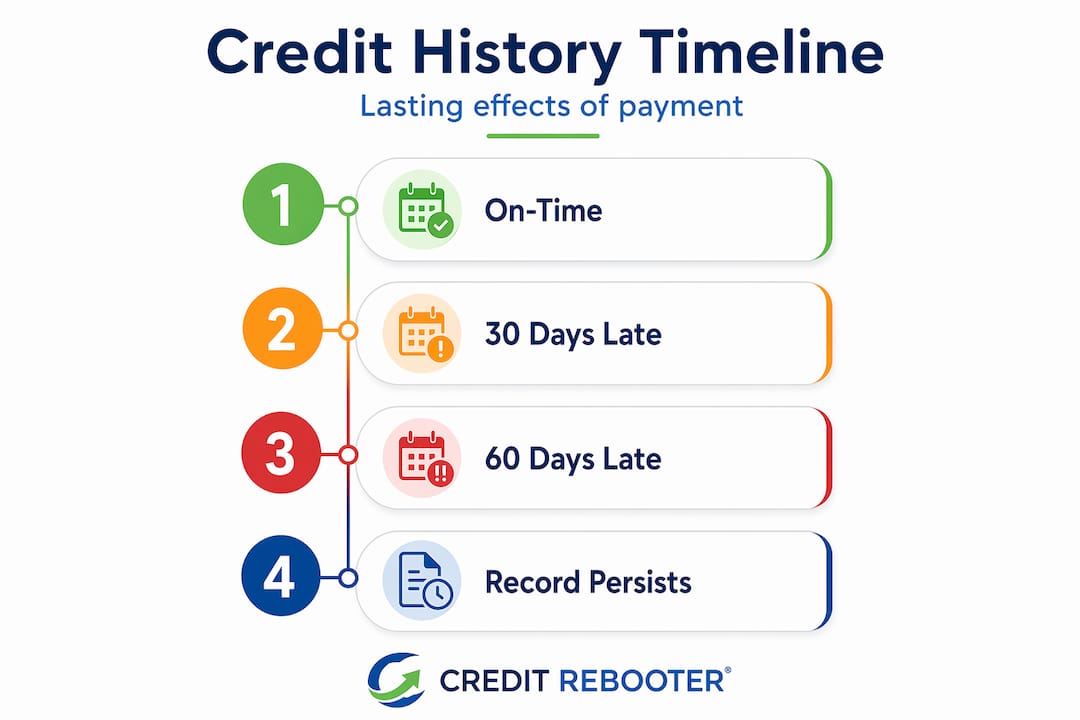
Here’s what typically stays on your credit report and for how long:
| Type of negative information | How long it stays on your report |
|---|---|
| Late payments (30+ days) | Up to 7 years |
| Collections accounts | Up to 7 years |
| Chapter 13 bankruptcy | Up to 7 years |
| Chapter 7 bankruptcy | Up to 10 years |
| Hard inquiries | Up to 2 years |
As the Consumer Financial Protection Bureau confirms, negative payment history can remain on your report for up to seven years, with bankruptcies lingering for up to a decade.
The good news: Older negative information carries less weight in scoring models. A late payment from six years ago matters much less than one from six months ago. Lenders do still see it, though, so it can still affect financing decisions for major purchases.
Key impacts of payment history on your credit record:
- On-time payments build positive history month after month, compounding over time
- One missed payment can cancel out months of positive behavior in your score
- Consistent improvement after a rough patch signals reliability to future lenders
- Automatic payments for at least the minimum due protect your record on every account
Pro Tip: Set calendar reminders or enroll in autopay for every recurring bill. One forgotten payment on a small account can create the same type of mark as a missed mortgage payment on your credit record.
Check out our improving payment history tips for a full breakdown of tactics that protect your record month to month.
Common misconceptions about credit history and how to improve it effectively
Here’s a misconception that costs people time and money: thinking that improving your credit is about hitting a specific score number. It’s not. Good credit reflects consistent, on-time payments and responsible borrowing. The score follows the behavior, not the other way around.
Two other common myths worth addressing:
- “Closing old accounts helps my credit.” It usually hurts. Closing accounts shortens your average credit age and reduces available credit, both of which can lower your score.
- “Checking my own credit hurts it.” Checking your own report is a soft inquiry. It has zero impact on your score.
Building credit from scratch and repairing damaged credit are related goals but they require different approaches. Here’s a direct comparison:
| Factor | Building credit history | Repairing credit history |
|---|---|---|
| Starting point | Little or no credit record | Negative marks, collections, or missed payments |
| Primary tools | Secured cards, credit-builder loans, authorized user status | Dispute errors, consistent payments, debt payoff |
| Timeline | 6 to 12 months for initial scoring | 12 to 24+ months for meaningful recovery |
| Biggest risk | Opening too many accounts at once | Continuing the behaviors that caused the damage |
| Best habit | Pay every balance in full monthly | Pay on time, every time, without exception |
Explore our credit building strategies if you’re starting from zero, or our building credit history guide if you need a more structured approach. If you’re working through existing damage, the credit score repair guide maps out a realistic recovery path.
Key behaviors that move the needle for both groups:
- Pay every bill on time, even if it’s only the minimum
- Keep credit card balances below 30% of the limit, ideally below 10%
- Avoid applying for multiple new accounts within a short window
- Give your history time. Accounts need months and years to show consistent patterns.
Pro Tip: If you’re rebuilding, becoming an authorized user on a family member’s or close friend’s long-standing, well-managed account can add positive history to your report without requiring you to open a new account.
Practical steps to check, maintain, and grow your credit history
You know what credit history basics cover. Now here’s exactly what to do about it.
Step-by-step actions to take this month:
- Pull all three credit reports from AnnualCreditReport.com and review every line.
- List any accounts with incorrect information, wrong payment statuses, or unfamiliar account numbers.
- File disputes online with the specific bureau reporting each error. You have the legal right to do this, and bureaus must correct errors for free.
- Set up autopay or payment reminders for every account, ensuring no bill goes past its due date.
- Check your credit utilization across all revolving accounts and pay down any balance above 30% of the limit.
- Review your credit repair steps to build a structured improvement plan.
Ongoing habits that protect and grow your record:
- Do not close old credit card accounts unless there’s a fee-based reason
- Space out any new credit applications by at least six months
- If you lack credit history, open one secured card and use it for one small recurring purchase each month
- Check your reports again every four to six months to catch new errors early
Small business owners have an additional layer to manage. Your personal credit often feeds into business financing decisions, especially early on. Keeping your personal record clean is one of the strongest moves you can make before applying for a business line of credit.
Pro Tip: Go to improving your credit score for a full action list broken down by credit score range. Where you start determines which steps deserve your attention first.
Why focusing on consistent payment behavior beats chasing credit scores
Here’s what 15 years of watching people try to fix their credit makes clear: most people who struggle do so because they’re playing the wrong game. They watch their score like a stock ticker, celebrating small jumps and panicking over small dips, while the actual driver of credit health, which is behavioral, sits on autopilot.
Credit scores fluctuate. They vary depending on which scoring model a lender uses, which bureau the data comes from, and when the inquiry hits. Your payment behavior does not fluctuate. It’s either consistent or it isn’t. And consistent positive payment habits, repeated month after month, are what translate into the kind of credit record that gets loans approved at favorable rates.
The uncomfortable truth about credit repair is that there are no meaningful shortcuts. Companies that promise to remove accurate negative information or dramatically boost your score in weeks are not being honest with you. What actually works is less exciting but entirely reliable: pay on time, keep balances low, fix errors in your reports, and let time do the rest.
What many people genuinely underestimate is the lasting damage a single late payment causes. A 30-day late payment can affect your scoring outcomes for years, far longer than the brief inconvenience that caused the miss in the first place. The asymmetry matters. Building takes consistency. Damage takes a moment.
The practical wisdom here is simple. Spend less energy watching your score and more energy building the habits lenders actually reward: timely payments, low utilization, and aged accounts. If you need a place to start, the tips for improving credit behavior on Credit Rebooter walk through the exact habits that move credit records in the right direction over time.
How Credit Rebooter can help you build and repair your credit history
Understanding why is credit history important is one thing. Doing something about it is another, especially when negative marks, errors, or a thin credit file are standing between you and the financing you need.

Credit Rebooter offers practical, personalized support for both individuals and small business owners working to build positive credit history from the ground up or recover from past setbacks. Our credit building strategies give you a clear roadmap tailored to your starting point, while our credit score repair guide walks through how to dispute errors, address collections, and rebuild your reputation with lenders. Before choosing any credit repair service, also review our credit repair warnings to make sure you’re working with a trustworthy provider. Your credit history is fixable. Let’s get to work.
Frequently asked questions
What is credit history in simple terms?
Credit history is a record of how you manage borrowed money and bills, including on-time and late payments, loans, and credit card usage that lenders use to assess your creditworthiness.
How long does negative information stay on my credit report?
Most negative information, like late payments, can remain on your credit report for up to seven years, while bankruptcies can stay for up to ten years.
Can I get a free copy of my credit report?
Yes, you can get a free copy of your credit report once every 12 months from each of the three major credit bureaus through AnnualCreditReport.com.
How does payment history affect my credit score?
Payment history is the biggest factor in your credit score, accounting for about 35% of FICO scores and 41% of VantageScore models, making timely payments crucial.
What can I do if I find errors in my credit report?
You have the right to dispute incorrect information for free, and the credit bureau and furnisher must correct any mistakes, which can improve your credit report faster than waiting for negative items to age off naturally.