
You’ve probably heard that applying for a credit card can hurt your credit score, and maybe that fear has stopped you from comparing rates or checking your own report. That anxiety is understandable. A 2026 Citi survey found that 68% of consumers find credit management confusing, and much of that confusion centers on understanding what is a credit inquiry and what it actually does to your score. This guide cuts through the noise so you can make smarter financial decisions without second-guessing every application.
Table of Contents
- Key Takeaways
- What is a credit inquiry and how does it work
- Hard vs. soft inquiries and your credit score
- How multiple inquiries are handled by scoring models
- How to monitor and manage credit inquiries
- My take on why credit inquiries cause so much unnecessary fear
- Take control of your credit with Creditrebooter
- FAQ
Key Takeaways
| Point | Details |
|---|---|
| Two types exist | Hard and soft inquiries work differently and only hard inquiries can affect your credit score. |
| Hard inquiry impact is small | A single hard inquiry typically lowers your score by up to five points, and the effect fades over time. |
| Rate shopping is protected | Scoring models treat multiple mortgage or auto loan inquiries within 14 to 45 days as one single inquiry. |
| Soft inquiries are invisible to lenders | Soft pulls appear only on your personal report and have zero impact on your credit score. |
| Fraudulent inquiries can be disputed | Unauthorized hard inquiries should be flagged and disputed to protect your credit health. |
What is a credit inquiry and how does it work
A credit inquiry is a formal record created when someone accesses your credit report to review your creditworthiness. According to the Consumer Financial Protection Bureau, this record documents any third party who pulled your credit to assess your financial profile. Think of your credit report as a file that tracks your borrowing history, and inquiries as the log of who has opened that file.
These requests happen for a wide range of reasons, and it helps to see concrete examples of credit inquiries to understand the full picture:
- Loan applications: When you apply for a mortgage, car loan, or personal loan, the lender pulls your credit to decide whether to approve you and at what interest rate.
- Credit card applications: Every time you apply for a new credit card, the card issuer runs a credit check.
- Rental applications: Many landlords check your credit before approving a lease to confirm you pay your bills reliably.
- Employment screening: Some employers, particularly in finance or government roles, request credit checks as part of a background screening process.
- Insurance underwriting: Certain insurance companies pull credit data to help determine premiums.
- Your own check: When you check your own credit report or score, that also generates a record, though it works very differently from the lender variety.
Two entirely different categories cover all of these examples: hard inquiries and soft inquiries. Who makes the request and why determines which type gets recorded. Lenders reviewing your application for new credit generate hard inquiries. Background checks, pre-screening offers, and self-checks generate soft inquiries. Understanding this difference between inquiry types is the first real step toward managing your credit confidently.
Hard vs. soft inquiries and your credit score
This is where most people get tangled up, so let’s be direct about the difference between a hard and soft inquiry.
A hard inquiry happens when a lender or creditor pulls your full credit report to make a lending decision. Hard inquiries can lower your score temporarily, typically by up to five points per inquiry. They appear on your credit report and can be seen by other lenders who review your file later.
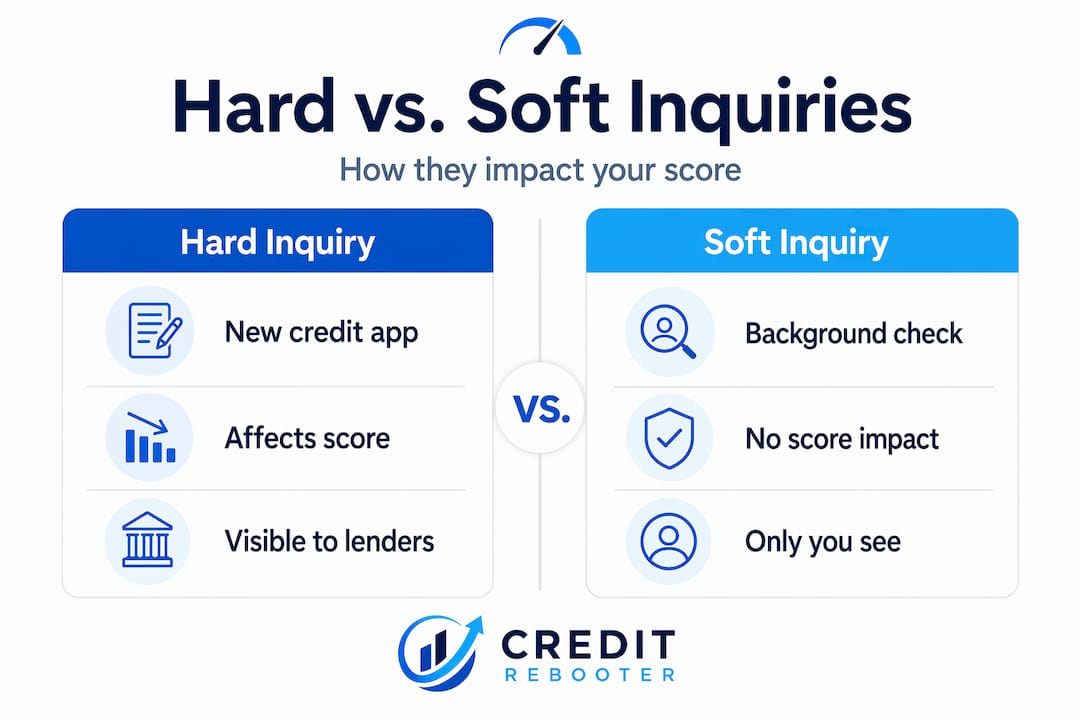
A soft inquiry, by contrast, happens in the background. Soft inquiries do not impact credit scores and are often triggered by prescreening, when lenders pull basic data to send you preapproved offers in the mail. When you check your own score through a free monitoring service, that is also a soft pull. These inquiries appear only to you on your personal report and do not influence any lender’s decision about your application.
Here is a side-by-side comparison of how the two types differ:
| Feature | Hard Inquiry | Soft Inquiry |
|---|---|---|
| Triggered by | New credit application | Pre-screening, self-check, background check |
| Affects credit score | Yes, temporarily | No |
| Visible to lenders | Yes | No |
| Duration on report | Up to two years | Visible only to you |
| Score impact fades | After approximately one year | N/A |
Hard inquiries stay on your credit report for up to two years, but the scoring impact typically fades well before that. Most models stop penalizing you for a hard inquiry after about twelve months. So if you applied for a store credit card last year and regretted it, the practical damage to your score has likely already passed.
Pro Tip: Before applying for any new credit, ask the lender whether they will perform a hard or soft pull. Some lenders offer pre-qualification checks that use a soft inquiry so you can see your likely approval odds without touching your score.
How multiple inquiries are handled by scoring models
Here is something that surprises most people. If you are shopping for a mortgage and apply with five different lenders in three weeks to compare rates, your score does not take five separate hits. Credit scoring models are smart about this.

The concept is called deduplication. FICO allows 45 days for mortgage-related inquiries to be counted as one, while VantageScore uses a 14-day window for the same purpose. This protection applies specifically to mortgage loans, auto loans, and student loans. It does not apply to credit card applications, which are each counted separately.
Knowing this changes how you should approach major financial decisions:
- For mortgages: Apply with multiple lenders within a 45-day window to get the best rate. Your score will reflect only one inquiry, not several.
- For auto loans: The same logic applies. Gather your quotes within a two-week period to keep your score intact.
- For student loans: Rate shopping is protected here too, though the window length varies slightly by scoring model.
- For credit cards: Each application is counted independently, so space them out by at least six months when possible to avoid stacking hard inquiries.
The key takeaway here is that rate shopping for big purchases is not the score-killing activity many people fear. The system is designed to reward smart financial comparison, not punish it.
Pro Tip: Mark the date of your first mortgage or auto loan application. Use that date as your countdown clock. Submit all comparison applications within the protected window so deduplication works in your favor.
How to monitor and manage credit inquiries
Knowing what credit inquiries are is one thing. Knowing how to stay on top of them is where the real protection happens. Here is a numbered process you can follow to manage your inquiries effectively:
-
Pull your credit reports regularly. You can access free reports from all three major bureaus at AnnualCreditReport.com. Review the inquiries section carefully to spot anything unfamiliar.
-
Identify unauthorized inquiries. If you see a hard inquiry from a company you never applied to, that is a red flag. Unauthorized inquiries can signal fraud and should never be ignored. Someone may be attempting to open credit in your name.
-
Dispute suspicious pulls in writing. Contact the credit bureau that shows the inquiry and file a formal dispute. You also have the right under federal law to contact the company that pulled your report and request verification of their permissible purpose. Familiarizing yourself with the laws in credit repair gives you a clear framework for doing this correctly.
-
Avoid unnecessary hard inquiries. Every time you apply for a retail store card at checkout to save 20%, you generate a hard inquiry. Those small-discount applications add up quickly and signal to lenders that you may be seeking credit aggressively. Review your options in credit repair to understand which application behaviors actually work against your goals.
-
Check your score regularly. Using a free monitoring tool that runs soft pulls lets you watch your score trend without adding hard inquiry entries to your report. Creditrebooter’s credit score check tool makes this easy to do from one place.
The goal here is not paranoia. It is routine awareness. Most inquiries on your report are completely normal. But catching one fraudulent pull early can save you from months of credit repair work later.
My take on why credit inquiries cause so much unnecessary fear
I have worked in credit education long enough to see the same pattern repeat itself. Someone avoids comparing mortgage rates because they are terrified of “ruining their credit.” Someone else never checks their own report because they think that counts against them. The fear is real, but it is built on misunderstanding, not fact.
What I have learned is that the anxiety around credit inquiries almost always comes from a lack of specifics. People know inquiries exist. They know they are “bad somehow.” But they never learn which ones matter, how much they matter, or for how long. That gap turns a minor, manageable concept into something that feels dangerous.
The part that genuinely matters is the pattern, not the individual inquiry. A single hard pull from a mortgage application is almost meaningless in the long run. Six credit card applications in two months tells a very different story to a lender.
Understanding credit inquiries is foundational to building real credit confidence. Not just knowing the vocabulary, but knowing how to act. If you take one thing from this, let it be this: checking your own credit never hurts you, rate shopping is protected, and most inquiry-related score drops are temporary. Stop letting fear of inquiries stop you from making smart financial moves.
— Meagan
Take control of your credit with Creditrebooter
Understanding credit inquiries is a strong start, but the bigger picture includes your full credit profile: payment history, balances, negative marks, and more.

At Creditrebooter, we built our resources specifically for people who want real answers and real results. Whether you are dealing with hard inquiries that have added up, errors on your report, or a score that just is not moving in the right direction, our credit score repair program walks you through every step. We also provide a free learning center where you can go deeper on topics like what is a credit inquiry, how different items affect your score, and what legitimate credit repair steps actually look like. Your credit can be repaired. Let us show you how.
FAQ
What is a credit inquiry exactly?
A credit inquiry is a record created when someone accesses your credit report. Hard inquiries are triggered by new credit applications and can affect your score. Soft inquiries, such as pre-screening checks or self-checks, do not.
How do credit inquiries affect your score?
Hard inquiries can lower your credit score by up to five points temporarily, with the impact fading after about twelve months. Soft inquiries have no effect on your score at all.
What is the difference between a hard and soft inquiry?
A hard inquiry is triggered when you apply for new credit and is visible to other lenders. A soft inquiry happens during background checks or self-reviews and is only visible to you, with no scoring impact.
Can you dispute an unauthorized credit inquiry?
Yes. If you spot a hard inquiry you did not authorize, you can file a dispute with the credit bureau and contact the company that pulled your report to demand verification of their permissible purpose.
Does checking your own credit hurt your score?
No. Checking your own credit generates a soft inquiry, which does not affect your score in any way. You can and should check your report regularly without any concern.