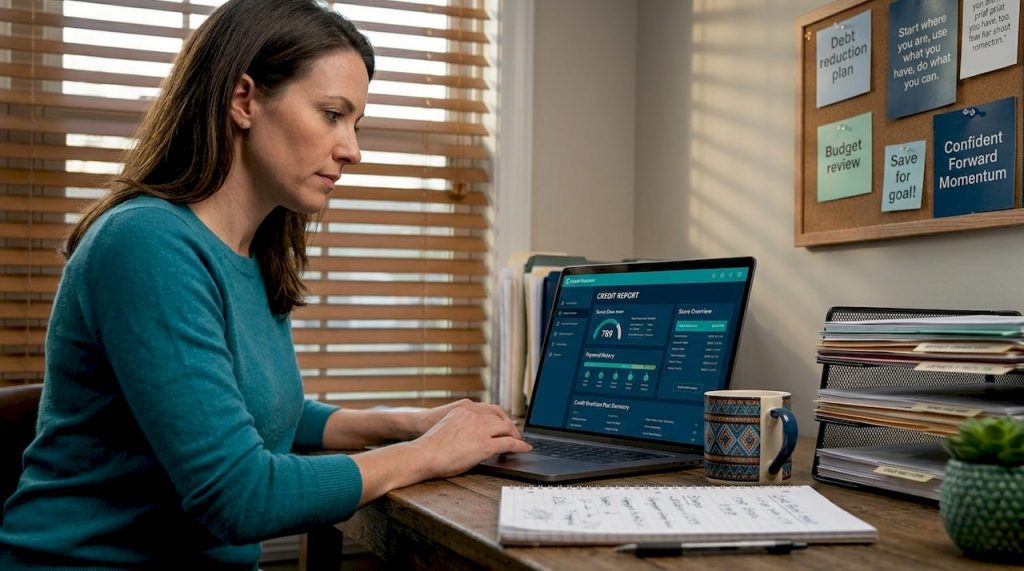
Nearly 1 in 4 small business loan applications are rejected each year because of poor business credit, and most owners never see it coming until they’re sitting across from a lender hearing “no.” This small business credit repair guide exists to change that outcome. Whether you’ve got late payments dragging down your profile, errors you didn’t even know were there, or a credit file so thin it reads as invisible, the path forward is concrete and actionable. We’re going to walk you through every step, from pulling your first report to opening vendor accounts that actually build your score.
Table of Contents
- Understanding business credit and why repair matters
- Preparing for credit repair: pulling reports and spotting issues
- Executing repair: disputing errors, reducing balances, and adding positive trade lines
- Verifying progress and maintaining strong business credit
- The overlooked truths about business credit repair
- Credit Rebooter solutions to empower your credit repair journey
- Frequently asked questions
Key Takeaways
| Point | Details |
|---|---|
| Separate business credit | Your business credit profile is distinct from personal credit and both matter for financing. |
| Dispute errors promptly | Correcting inaccurate credit report information can quickly improve your credit score. |
| Pay early and reduce debt | Early vendor payments and lowering credit utilization boost your credit faster. |
| Monitor regularly | Frequent credit report checks help catch errors and prevent fraud. |
| Be patient and consistent | Credit repair takes months, steady positive payments over time are crucial. |
Understanding business credit and why repair matters
Business credit is not your personal credit with a different label. It is a separate financial profile that lenders, suppliers, and even landlords use to evaluate the risk of doing business with your company. It lives with specialized bureaus, namely Dun & Bradstreet, Experian Business, and Equifax Business, and it scores your company based on payment history, credit utilization, company age, and public records like liens or bankruptcies.
Here is what makes this personal for your bottom line. A strong business credit profile unlocks lower interest rates on loans, better payment terms from vendors such as net-60 instead of cash-on-delivery, higher credit limits, and reduced insurance premiums in some states. A weak profile does the opposite: it either shuts you out of financing entirely or forces you into high-interest products that quietly bleed your cash flow.
Most owners assume personal credit carries all the weight. It carries some. Both business and personal credit are checked by most lenders, especially SBA-approved institutions, which is why repairing your business profile while protecting your personal score is the right dual strategy. That said, business credit is the profile you have the most direct control over, and it can improve faster than personal credit when you take deliberate steps.
Key reasons business credit repair matters right now:
- Funding access: Banks and alternative lenders both screen business credit before approving capital
- Vendor relationships: Suppliers extend better net terms to businesses with clean payment histories
- Business credibility: A strong profile signals to partners and contractors that you are reliable
- Personal protection: Good business credit reduces the need to personally guarantee every debt
- Growth speed: Companies with strong credit can move fast on inventory, equipment, and expansion
Understanding credit repair laws that govern how bureaus must respond to disputes also gives you real leverage before you start the process.
Now that you understand why business credit matters, let’s prepare by assessing your current credit status.
Preparing for credit repair: pulling reports and spotting issues
You cannot fix what you cannot see. Pulling your business credit reports is the first concrete action in any guide to business credit restoration, and it is not as simple as the free annual report you might use for personal credit.

Business credit reports are available from Dun & Bradstreet, Experian Business, and Equifax Business, and each charges a fee for access. Dun & Bradstreet also requires you to register for a D-U-N-S number, which is your unique business identifier, before a profile can even be built. If you do not have one yet, register at no cost directly through their website. Plan to pull reports from all three bureaus because vendors and lenders may report to different ones.
Once you have your reports, you are looking for specific categories of damage. About 25% of small business credit reports contain errors worth disputing, which means there is a real chance something on your file is wrong and fixable within weeks, not months.
Common issues to identify in your reports:
- Late payments listed incorrectly or already paid but still showing delinquent
- Accounts that do not belong to your business
- Outdated negative items that should have aged off
- Collections listed without proper notice or validation
- Incorrect business information such as wrong address, wrong EIN, or misspelled legal name
- High credit utilization across revolving accounts
What to document before you dispute:
- Contracts, invoices, and receipts that prove payment dates
- Bank statements showing cleared payments
- Written correspondence with vendors or lenders
- Any payment confirmation emails or receipts
Pro Tip: Create a simple spreadsheet tracking every account on your report, the bureau reporting it, the balance, status, and your documentation. This turns a messy process into a manageable workflow you can update weekly.
| Issue type | How damaging | Time to dispute or fix |
|---|---|---|
| Report error (wrong account) | High | 30 to 45 days |
| Late payment (inaccurate) | High | 30 to 45 days |
| Late payment (accurate) | Medium | 7 years, goodwill optional |
| High utilization | Medium | 1 to 3 months |
| Collection account | High | 30 to 45 days or goodwill |
| Thin file (no history) | Medium | 3 to 6 months with trade lines |
For owners ready to take action without hiring anyone, our DIY credit repair tips break down exactly what you can dispute, and how to do it without paying a service.
With your reports in hand and issues identified, you’re ready to start the repair process.
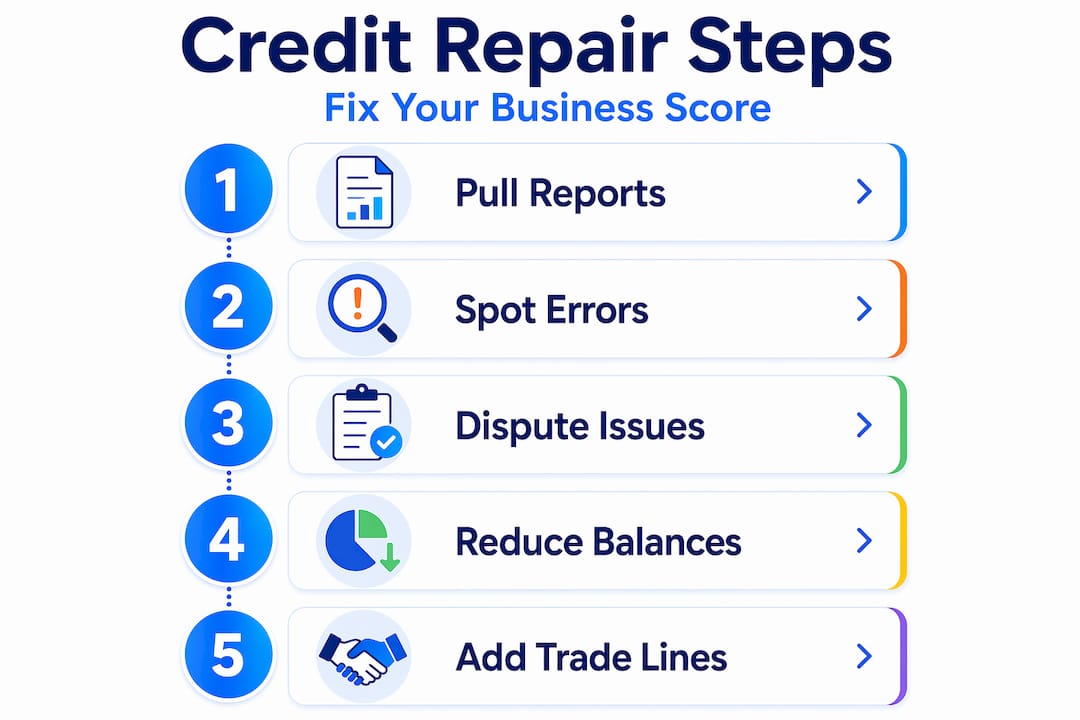
Executing repair: disputing errors, reducing balances, and adding positive trade lines
This is where actual credit repair strategies for startups and established businesses diverge from theory and become real work. There are three parallel tracks to run simultaneously: clean up negatives, reduce utilization, and add new positive history.
Step-by-step dispute process:
- Write a formal dispute letter to the bureau reporting the error, naming the account, the specific error, and the correction you are requesting
- Attach documentation: bank statements, invoices, cleared checks, or correspondence
- Send via certified mail to create a paper trail with a timestamp
- Disputes are investigated within 30 days by business credit bureaus, and corrected errors can update your profile quickly
- Follow up in writing if the bureau does not respond or verifies an item you believe is wrong
- Escalate to the creditor directly if the bureau upholds an error without adequate investigation
Reducing your utilization:
Keeping credit utilization below 30% is one of the fastest mechanical improvements you can make. If your business has a $50,000 revolving credit line and carries a $40,000 balance, that 80% utilization is actively hurting your score every month. Pay down your highest-utilization accounts first. Even dropping from 80% to 45% shows measurable improvement.
Adding positive trade lines:
Opening vendor accounts that report payment activity to the business credit bureaus is one of the most underused credit repair strategies for startups. Look for suppliers that offer net-30 terms, meaning you have 30 days to pay your invoice, and specifically confirm they report to Dun & Bradstreet, Experian Business, or Equifax Business. Many common business suppliers, including office supply vendors and shipping providers, offer these accounts with no hard credit pull.
Paying vendors early matters more than most owners realize. Your Dun & Bradstreet PAYDEX score runs from 0 to 100, and paying before the due date, not just on time, pushes your score into the top range. On-time is good. Early is better.
Pro Tip: Some vendors will remove a one-time late payment from your file if you write a goodwill letter and have a consistent payment history with them. This is not guaranteed, but it costs you nothing to ask and works more often than owners expect.
| Credit repair action | Effect on score | Timeline |
|---|---|---|
| Dispute and correct report error | High positive | 30 to 45 days |
| Add net-30 vendor trade line | Medium positive | 1 to 3 months |
| Pay utilization below 30% | High positive | 1 to 2 months |
| Request goodwill late payment removal | Medium positive | 30 to 60 days |
| Let a collection account age | Low positive | 3 to 7 years |
For deeper reading on building this process end to end, our credit repair strategies page and the credit repair steps overview are worth bookmarking now.
After repairing negatives and adding positives, you’ll want to verify progress and learn ongoing maintenance strategies.
Verifying progress and maintaining strong business credit
Repairing business credit is not a one-and-done project. It is a habit. Small business credit improvement that sticks requires monitoring and consistent behavior after the initial cleanup work is done.
“Business credit is like a garden. The repair is the clearing, but the maintenance is what makes it grow.”
Ongoing monitoring habits that protect your progress:
- Pull updated reports from all three bureaus every quarter, not just once a year
- Set up monitoring alerts where available through Dun & Bradstreet and Experian Business
- Review every new account that appears on your report to catch fraud or misreporting early
- Confirm that your newly opened vendor accounts are actually reporting payments
- Keep your business address, legal name, and contact information identical across every vendor, creditor, and bureau record
How long repair realistically takes:
New positive trade lines can move scores within 1 to 3 months, but building a fully repaired profile with strong history takes 12 to 24 months of consistent behavior. This timeline shortens dramatically if you dispute errors aggressively, add multiple reporting vendor accounts, and keep utilization low without missing a payment.
Regular credit monitoring helps catch fraud and errors before they compound. A vendor that misreports a late payment can undo months of progress if you are not watching closely.
Pro Tip: Keep your business finances completely separate from personal. A dedicated business checking account, business credit card, and EIN used consistently across all vendor applications creates a cleaner credit file that bureaus can read accurately.
Our resource on credit monitoring tips covers the specific tools and check-in schedules that work best for small business owners managing this themselves.
With your credit on the mend and maintenance plan ready, here’s a fresh perspective on credit repair many miss.
The overlooked truths about business credit repair
Most owners come to credit repair focused on one thing: disputing errors. That instinct is not wrong, but it is incomplete, and chasing disputes while ignoring the behaviors that created the damage is like bailing out a boat without patching the hole.
Here is the part nobody says clearly enough: stopping new negatives before disputing old ones gives you compounding results. If you dispute three accounts in month one but continue carrying 85% utilization and miss a vendor payment in month two, you end your dispute period in roughly the same place you started. The sequence matters. Stop the bleeding first.
The second thing worth saying out loud is that early and consistent vendor payments often move credit scores faster than sophisticated dispute campaigns. This is not because disputes do not work, they absolutely do. It is because positive payment history is the single heaviest factor in most business credit scores, and you can generate it every month without any special knowledge or fees.
The third truth is about professional credit repair services. They can help with complex disputes and saving you time, but they cannot legally remove accurate negative items, and they cannot do anything you cannot do yourself with a few certified letters and documentation. The Credit Repair Organizations Act governs what these companies can and cannot promise. Paying a monthly fee for basic services you can run yourself is money that could go toward paying down the balances hurting your score. There are specific situations where professional help makes sense, particularly when disputes are being ignored or when the volume of errors is genuinely overwhelming. But the starting assumption should always be that you can handle this.
One practical insight that gets ignored in most small business financial health guides: your business name, address, and EIN need to be identical everywhere. A vendor reporting under a slightly different business name than what is on file at the bureau will not match your profile, and those payments will not help your score. Uniformity is unglamorous but it is one of the highest-leverage fixes available.
Credit Rebooter solutions to empower your credit repair journey
You have the roadmap. Now the question is how much of it you want to tackle alone.

At Credit Rebooter, we built our platform specifically for business owners and individuals who want real guidance without the guesswork or the scams. Our credit score repair services give you a clear picture of where your credit stands and what to tackle first. For those ready to move forward themselves, our business credit repair strategies resource center covers dispute templates, vendor account recommendations, and utilization strategies you can apply this week. And before you hire any outside service, check our credit repair warnings page to know exactly which promises are red flags and which services are actually worth your time and money.
Frequently asked questions
Can I repair my small business credit on my own for free?
Yes. DIY business credit repair is fully possible by disputing errors directly with the bureaus, adding vendor trade lines, and managing your payment history, all at no cost beyond pulling your reports.
How long does business credit repair typically take?
Disputing errors resolves in 30 to 45 days, while full repair timelines range from 12 to 24 months depending on how severe the damage is and how consistently you add positive payment history.
Does my personal credit affect my small business credit?
Your business and personal profiles are separate, but both credit profiles are reviewed by most lenders, especially SBA lenders, which is why maintaining both matters for financing eligibility.
What are the best ways to improve my Dun & Bradstreet PAYDEX score?
Pay vendor invoices before the due date, not just on time, since early vendor payments push your PAYDEX score higher than on-time payments alone, and add multiple net-30 accounts that report to the bureau.
Are credit repair companies worth it for small business owners?
For most owners, no. Credit repair professionals cannot legally remove accurate negative items, and the core steps are available to any owner willing to do the work themselves without paying a monthly fee.