A single error buried in your credit report can cost you thousands of dollars over the life of a loan. An FTC study found that 12.9% of consumers had errors on their reports that led to score changes after disputes, with 5.2% of those people shifting into different risk tiers entirely. That shift can mean higher interest rates, rejected applications, or worse loan terms on a mortgage or car loan. Checking your credit report regularly is one of the most powerful and underused financial habits available to you. This article breaks down exactly why it matters, what to look for, and how to take action.
Table of Contents
- How credit report errors affect your financial life
- Top reasons to check your credit report regularly
- Credit reports for small business owners: Why they matter
- Personal vs. business credit reports: Key differences
- Our take: The surprising power of simple habits in credit health
- Take your next step toward better credit
- Frequently asked questions
Key Takeaways
| Point | Details |
|---|---|
| Report errors are common | About 13% of Americans have errors that can change their credit scores and financial opportunities. |
| Regular checks protect you | Frequent credit report reviews help detect fraud, errors, and negative marks before they impact your finances. |
| Business owners face unique risks | Small business loan approvals and vendor terms often hinge on both business and personal credit scores. |
| Know your rights and differences | Personal credit reports offer more protections than business reports—understanding this helps safeguard your credit. |
| Small actions drive big outcomes | Proactive monitoring and corrections can mean lower interest rates, better loans, and greater financial security. |
How credit report errors affect your financial life
Your credit report is more than a record of how you’ve borrowed money. It’s a snapshot that lenders, landlords, employers, and even insurers use to make decisions about you. When that snapshot contains errors, the consequences reach further than most people expect.
The most direct impact is on your credit score. Incorrect late payments, accounts that don’t belong to you, or outdated balances can drag your score down significantly. A lower score means you pay more to borrow money, period. If you’re shopping for a mortgage, even a 20 to 30 point difference in your score can push you from one interest rate tier to the next, adding tens of thousands of dollars to the total cost of your loan over 30 years.

Credit risk tiers are the ranges lenders use to decide what interest rate to offer you. Most lenders break scores into groups like excellent (750 and above), good (700 to 749), fair (650 to 699), and poor (below 650). Moving from “good” to “fair” because of a reporting error isn’t a small nuisance. It can mean the difference between a 6% and an 8% mortgage rate, a real cost that compounds for decades.
Here’s a quick look at how score tiers can affect your loan costs:
| Credit score range | Risk tier | Typical impact on auto loan rate |
|---|---|---|
| 750 and above | Excellent | Lowest rates available |
| 700 to 749 | Good | Slightly higher rates |
| 650 to 699 | Fair | Noticeably higher rates |
| Below 650 | Poor | Highest rates or denial |
Common errors that cause these problems include:
- Accounts you never opened, which could signal identity theft
- Wrong payment history, showing late payments you actually made on time
- Duplicate accounts listed more than once
- Incorrect personal information like a misspelled name or wrong Social Security number
- Outdated negative items that should have aged off your report
The FTC study that found errors in nearly 13% of consumer reports also confirmed that disputing those errors led to real, measurable score improvements. That’s not a small or irrelevant group of people. That’s roughly 1 in 8 Americans carrying around inaccurate information that’s actively working against them.
“One in five consumers had an error on at least one of their three credit reports.” — Federal Trade Commission
Starting with monitoring your score regularly is the foundation. Once you know your baseline, you can spot movement and investigate the cause. Our credit reports guide walks through each section of a report in plain language, so you know exactly where to look and what each item means.
Top reasons to check your credit report regularly
With the risks clear, it’s important to understand exactly why and how often you should check your report. Many people check once a year, if at all. But given how quickly things can go wrong, and how long errors can linger undetected, more frequent checks are smarter.
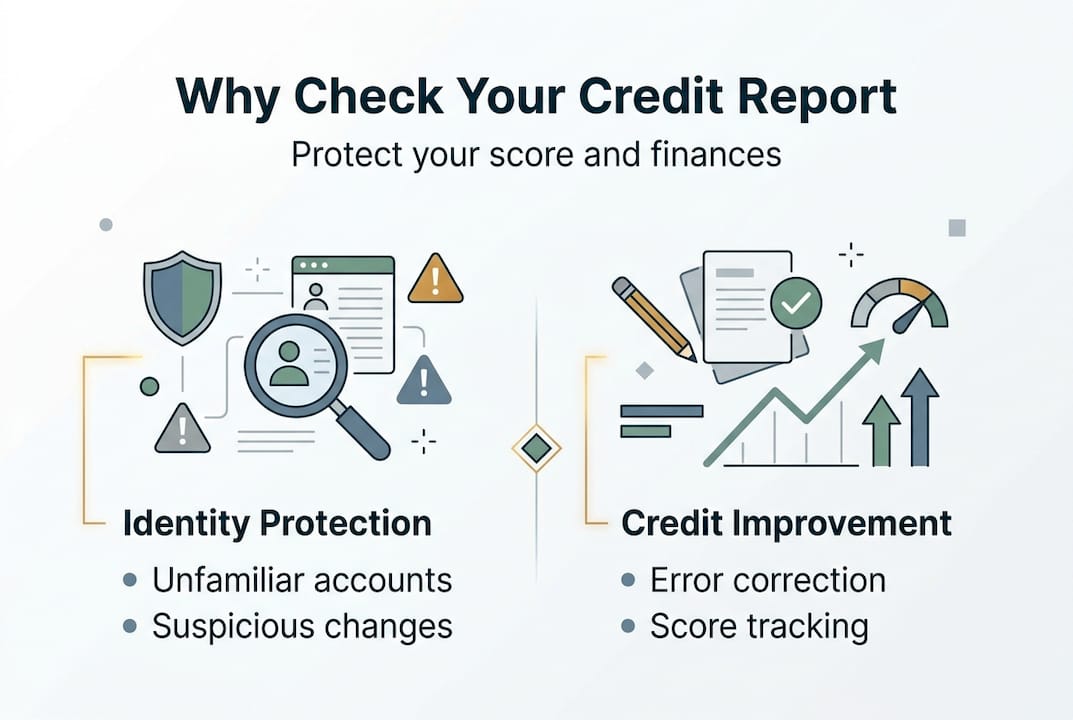
Here are the four most important reasons to check your credit report on a regular basis:
-
Spot identity theft early. Criminals open accounts in your name and let them go to collections before you even know what happened. Unfamiliar accounts or hard inquiries you don’t recognize are red flags. The sooner you catch these, the less damage they do.
-
Track hard inquiries. Every time you apply for credit, a hard inquiry appears on your report. Too many hard inquiries in a short window signals financial desperation to lenders and can lower your score. Reviewing your report helps you catch unauthorized inquiries and understand how your applications are affecting your standing.
-
Make sure old negatives are removed. Under the Fair Credit Reporting Act (FCRA), most negative items must be removed after seven years, and Chapter 7 bankruptcies after ten years. These don’t always fall off automatically. Checking your report lets you verify that old items have been cleared.
-
Keep your score accurate before major decisions. If you’re planning to apply for a mortgage, car loan, or business financing in the next six to twelve months, checking your report now gives you time to fix errors before they affect your application.
Pro Tip: You can access your credit reports free every week at AnnualCreditReport.com, the only federally authorized source. Pull reports from all three bureaus (Equifax, Experian, and TransUnion) because errors don’t always appear on all three.
According to FTC consumer guidance, checking your reports helps you catch identity theft through unfamiliar accounts and inquiries, review hard inquiries that may impact your score, and ensure old negatives have been properly removed per FCRA timelines.
Here’s a quick reference for FCRA removal timelines:
| Negative item type | Time limit on your report |
|---|---|
| Late payments | 7 years |
| Collections accounts | 7 years |
| Chapter 13 bankruptcy | 7 years |
| Chapter 7 bankruptcy | 10 years |
| Hard inquiries | 2 years |
If you suspect your identity has been compromised, our identity theft credit repair resource lays out a clear action plan. For older negative marks that should be coming off, learn more about removing old negatives and what to do when bureaus don’t update automatically.
Credit reports for small business owners: Why they matter
Individual credit matters, but for business owners, understanding both personal and business credit is vital. Running a business without knowing your credit standing is like driving without a dashboard. You may think everything is fine right up until something breaks.
Business credit scores, such as those from Dun and Bradstreet’s Paydex system, Experian Business, or Equifax Business, are used by lenders, insurance carriers, and vendors to evaluate your company’s financial reliability. A strong business credit score can help you secure better loan terms, pay lower insurance premiums, and negotiate favorable payment terms with suppliers.
According to U.S. Chamber of Commerce data, 20% of small business loans are denied due to poor business credit. Strong scores also lower insurance costs and lead to better vendor terms. And critically, lenders often check personal credit too, especially for businesses with fewer than five years of history.
Here’s how personal and business credit compare in terms of impact on your business:
| Factor | Personal credit impact | Business credit impact |
|---|---|---|
| Loan approval | Required for most small biz loans | Increasingly important as business grows |
| Insurance rates | Sometimes reviewed | Directly used by commercial insurers |
| Vendor terms | Rarely used | Major factor in net-30 or net-60 terms |
| Credit limits | Personal cards | Business cards and credit lines |
As a small business owner, here’s what you should focus on:
- Build business credit separately by registering your business, getting a DUNS number, and opening dedicated business accounts
- Pay vendors and suppliers on time, because business credit scores are built largely through trade lines with suppliers
- Monitor both reports, since a personal credit issue can spill over into business financing
- Separate your finances, because mixing personal and business expenses makes it harder to build a solid business credit history
Pro Tip: Many new business owners don’t realize their personal credit score is just as important as their business score when applying for small business loans. Lenders look at both when your business is young or doesn’t yet have substantial revenue.
Use our small business credit checklist to make sure you’re covering all the bases before applying for financing. Our business credit report guide explains how business credit scoring works and what steps to take to build a strong profile.
Personal vs. business credit reports: Key differences
To truly protect your finances, it helps to know what makes personal and business credit reports distinct. Most people assume the same rules apply to both. They don’t, and that gap in understanding can leave business owners seriously exposed.
Personal credit reports are regulated by the Fair Credit Reporting Act (FCRA), a federal law that gives consumers specific rights. These include the right to dispute inaccurate information, the right to free annual reports, and time limits on how long negative information can stay on your file. Most negatives must be removed after seven years. Under FCRA, bureaus must investigate disputes and respond within 30 days.
Business credit reports operate under different rules entirely. There is no equivalent federal law protecting business owners the way FCRA protects individuals. Negative information can stay on a business report indefinitely. Business reports are also public records, meaning competitors, vendors, or anyone willing to pay for a report can see your business credit file. You typically have to purchase your own business credit report, unlike the free access available for personal reports.
Here’s a side-by-side comparison of the key regulatory differences:
| Feature | Personal credit report | Business credit report |
|---|---|---|
| Governing law | FCRA (federal protection) | No specific federal law |
| Dispute rights | Clearly defined under FCRA | Limited, varies by bureau |
| Negative item time limit | 7 to 10 years | No time limit |
| Free access | Yes (AnnualCreditReport.com) | No, must be purchased |
| Public record | No | Yes |
This distinction matters more than most business owners realize. An old collection from five years ago on your personal report will eventually age off. That same type of item on your business report could sit there permanently unless you actively work to address it.
The CFPB reported a 182% surge in credit reporting complaints in 2024, with most related to incorrect information. Some bureaus have also been reducing their dispute relief rates, meaning fewer disputes result in corrections. That trend makes self-advocacy and regular monitoring more important than ever.
“Business owners who don’t track their business credit profile are flying blind when it comes to financing opportunities and risk exposure.”
Under FCRA personal protections, individuals have clear dispute rights, time limits on negative information, and free access to their reports. Business owners don’t have those same built-in guardrails, so staying proactive is the only real defense. Review our credit disclosure differences page to understand your rights and what information credit bureaus can and cannot share.
Our take: The surprising power of simple habits in credit health
Here’s something we’ve seen repeatedly: most people who struggle with credit aren’t making huge financial mistakes. They’re just not looking. They assume their reports are accurate. They assume old negatives fell off on their own. They assume they’d know if something went wrong. And then they apply for a mortgage or a business loan and find out, at the worst possible moment, that something has been quietly working against them for years.
The real power of thoughtful credit improvement isn’t in one dramatic fix. It’s in the habit of regular, routine awareness. People who check their reports consistently don’t just catch errors faster. They also understand their finances better, make smarter borrowing decisions, and feel less anxious about major financial moves because they’re not flying blind.
Chasing quick fixes is tempting. But sustainable credit health is built on patience, repetition, and small corrections made early before they compound into bigger problems. The consumers who achieve lasting financial stability are the ones who treat their credit report not as a one-time problem to solve, but as an ongoing tool to use.
Take your next step toward better credit
Ready to act on what you’ve learned? Here’s where to find tailored support and tools for better credit.

Understanding your credit report is just the beginning. The real transformation happens when you take that knowledge and put it to work with the right support. At Credit Rebooter, we offer practical tools and personalized guidance for both individuals and small business owners who want to move from awareness to real progress. Whether you’re just starting to focus on improving your credit score or you’ve encountered setbacks and need to understand warning credit repair practices to avoid, we’re here to help you navigate it all. Explore our credit score repair resources and take the first step toward the financial future you’re working toward.
Frequently asked questions
How often should I check my credit report?
You should check your credit report at least once a year, but weekly free access is available at AnnualCreditReport.com, which gives you a significant advantage for spotting problems early.
Will checking my credit report hurt my score?
Checking your own credit report is considered a soft inquiry and has absolutely no effect on your credit score, so you can review it as often as you need to.
What is the difference between a personal and a business credit report?
Personal credit reports fall under FCRA protections with free access and dispute rights, while business reports have no federal time limits on negatives, require payment to access, and are available to the public.
How can errors on my credit report affect my finances?
Errors can lower your score and shift you into higher risk tiers, leading directly to worse loan terms, higher interest rates, or outright denied applications.
How can I dispute an error on my credit report?
You can file a dispute online, by mail, or by phone with each credit bureau individually. Always include supporting documentation and follow up in writing to create a clear record of your dispute.