Most Americans want better credit, but wanting it and knowing how to get it are very different things. 92% of consumers took steps to improve their credit last year, yet costly mistakes like high utilization and unnecessary hard inquiries remain widespread. The gap between effort and results comes down to one thing: education. When you truly understand how credit works, what moves the needle, and what quietly drags your score down, you stop spinning your wheels and start making real progress toward the home, car, or business financing you need.
Table of Contents
- What credit education means and why it matters
- The essential skills and habits from credit education
- Common pitfalls and edge cases: what most people miss
- Building business credit: a guide for entrepreneurs
- Why smart credit education beats generic quick-fixes
- Explore credit education tools and personalized support
- Frequently asked questions
Key Takeaways
| Point | Details |
|---|---|
| Education yields lasting benefits | Learning about credit empowers informed choices and lower loan rates for major purchases. |
| Avoid common credit mistakes | Missteps like closing old accounts or skipping report checks can harm your score unexpectedly. |
| Business credit protects assets | Building separate business credit gives entrepreneurs better terms and protects personal finances. |
| Ongoing habits matter most | Regular report checks, balanced usage, and autopay are key to long-term credit health. |
| Expert support accelerates progress | Guides and tools help both individuals and business owners improve their credit for large purchases. |
What credit education means and why it matters
Credit education is not just reading a blog post or checking your score once a month. It means developing a working understanding of how credit scores are calculated, what goes into your credit report, and what lenders actually look for when they review your application. Think of it as learning the rules of a game you are already playing whether you realize it or not.
Your credit score is built on five core factors: payment history (35%), credit utilization (30%), length of credit history (15%), credit mix (10%), and new inquiries (10%). Each factor responds differently to your behavior. Pay a bill 30 days late and payment history takes a hit. Max out a credit card and utilization spikes. Apply for three new cards in a month and inquiries stack up. Understanding these levers lets you make intentional decisions instead of accidental ones.
“Credit education empowers informed decisions, avoiding pitfalls like high utilization or unnecessary inquiries, leading to lower interest rates on mortgages and auto loans for major purchases and long-term financial stability.” — FDIC
For consumers preparing for major purchases, this knowledge translates directly into dollars saved. A borrower with a 760 credit score typically qualifies for a mortgage rate that is a full percentage point or more lower than a borrower at 680. On a $300,000 home loan, that difference adds up to tens of thousands of dollars over the life of the loan.
Small business owners have even more at stake. Many entrepreneurs start out funding their business entirely on personal credit, which puts personal assets at risk and limits how much financing they can access. Learning how to improve your credit score on both a personal and business level is the foundation for sustainable growth. Credit education teaches owners to separate those two financial identities early, which protects personal finances and builds a stronger borrowing profile for the business.
Key benefits of credit education include:
- Lower interest rates on mortgages, auto loans, and personal loans
- Higher approval odds for credit cards, business loans, and rental applications
- Better negotiating power with lenders when you understand your profile
- Faster recovery from financial setbacks like medical debt or job loss
- Clearer path to major financial goals like homeownership or business expansion
The essential skills and habits from credit education
Understanding why credit education matters opens the door to the core skills and habits it teaches. These are not abstract concepts. They are practical actions you can take this week to shift your score in the right direction.
Here are the foundational skills credit education builds:
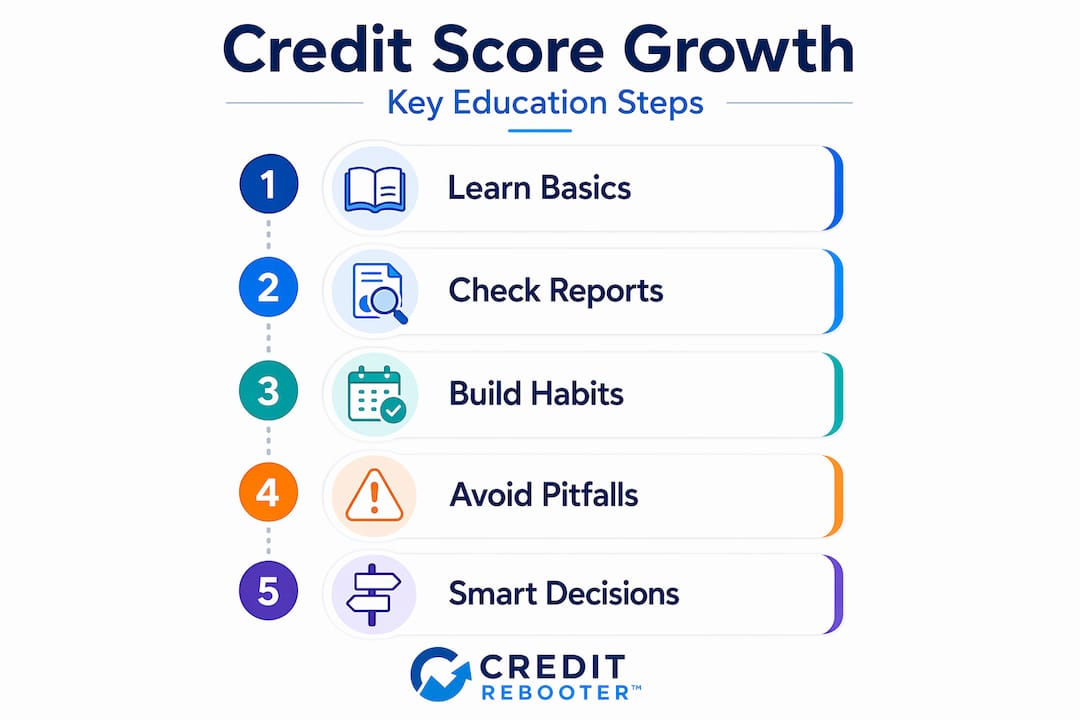
- Pull and review your credit reports. You have three reports, one from each major bureau. Errors are more common than most people expect, and 1 in 5 reports contain errors that can drag your score down. Checking your reports regularly at AnnualCreditReport.com costs nothing and can catch problems before they do serious damage.
- Dispute inaccurate information. When you spot an error, you have the legal right to dispute it with the bureau. This process can remove negative marks that do not belong on your report and lift your score in a matter of weeks.
- Manage credit utilization intentionally. Keeping your utilization below 30% across all cards is a widely taught benchmark, but aiming for under 10% gives you even better results. If your limit is $5,000, that means keeping your balance under $500 for the best scoring outcome.
- Protect your credit age. The average age of your accounts matters. Closing an old card you no longer use might feel responsible, but it can shorten your credit history and lower your score.
- Use autopay strategically. Setting up autopay for at least the minimum payment on every account eliminates the risk of a missed payment wrecking your payment history score.
- Limit hard inquiries. Every time you apply for new credit, a hard inquiry is recorded. Too many in a short window signals financial stress to lenders. Rate shopping for a mortgage or auto loan within a 14 to 45 day window usually counts as a single inquiry, depending on the scoring model.
Pro Tip: Set a calendar reminder every 4 months to pull one of your three credit reports. This way you are reviewing a fresh report roughly every quarter without having to pay for monitoring services. Pair this habit with the tips for improving your credit score available at Credit Rebooter for a complete self-monitoring system.
Building these habits takes time, but the compounding effect is significant. A consumer who checks their report, disputes errors, and keeps utilization low consistently will see meaningful score improvement within 3 to 6 months. Combine that with the steps to credit repair for a structured approach that covers both prevention and recovery.

Common pitfalls and edge cases: what most people miss
While basic credit habits are powerful, education helps you spot nuanced scenarios that can trip up even careful consumers and business owners. These are the situations where well-intentioned moves can backfire without warning.
The table below compares common credit actions and their actual effects:
| Action | What most people think | What actually happens |
|---|---|---|
| Balance transfer to 0% card | Always saves money and boosts score | May close old account, shortening credit history |
| Enrolling in a debt management plan | Immediately improves credit standing | Causes short-term score dip from account closures |
| Credit builder loan | Safe way to build credit from scratch | Can hurt those with existing delinquencies |
| Closing unused cards | Cleans up your profile | Increases utilization ratio and shortens credit age |
| Co-signing a loan | Helps a friend without affecting you | Adds the full debt to your credit profile |
According to research, balance transfers can close old accounts, directly harming your credit age and history, which makes up 15% of your total score. If you transfer a balance to a new card and the old card is closed either by you or the issuer, that history disappears. Over time, this lowers the average age of your accounts and can drop your score even as your debt decreases.
Credit counseling and debt management programs (DMPs) are another area where short-term pain is often misunderstood. When you enroll in a DMP, creditors frequently close your accounts as part of the agreement. This causes an immediate score dip. The long-term trajectory is usually positive as you pay down debt and build a clean payment record, but many people panic when their score drops at enrollment and abandon the plan prematurely. Learning what to expect through quality debt counseling solutions prevents that mistake.
Credit builder loans are marketed as a no-risk solution for building credit from zero. For people with no credit history, they often work well. But research shows these loans produce null average effects for the broader population and can actually harm those with existing delinquencies because the added monthly obligation becomes another payment to miss. Before committing to a credit builder loan, review your existing obligations carefully.
Pro Tip: Before making any move that seems like it should obviously help your credit, ask yourself: does this change my utilization ratio, my credit age, or my payment history? If the answer to any of those is yes, research the specific impact first. The credit score repair tips at Credit Rebooter cover these edge cases in practical detail.
Building business credit: a guide for entrepreneurs
These edge cases also matter for entrepreneurs. Credit education is just as essential for business owners as it is for individual consumers, and the stakes are often higher. A business that operates entirely on the owner’s personal credit is fragile. One bad quarter, a slow-paying client, or an unexpected expense can damage personal credit and put personal assets at risk.
Building separate business credit is a structured process with clear steps. For small business owners, the foundation starts with an Employer Identification Number (EIN), a D-U-N-S number from Dun & Bradstreet, a dedicated business bank account, and vendor relationships that report payment history to business credit bureaus. Business credit cards add another reporting layer and help establish a track record separate from personal finances.
| Business credit milestone | What it does |
|---|---|
| Obtain EIN | Establishes business as separate tax entity |
| Register for D-U-N-S number | Creates business credit file with Dun & Bradstreet |
| Open business bank account | Separates business and personal cash flow |
| Set up net-30 vendor accounts | Builds payment history on business credit report |
| Get a business credit card | Adds revolving credit history to business profile |
The benefits of this separation are significant. Business credit lines do not show on personal credit reports, so business borrowing does not inflate your personal utilization ratio. Business financing also tends to offer higher credit limits because it is evaluated on business revenue and financial performance rather than personal income alone.
For a deep look at this process, explore building business credit and use the business credit checklist to track each milestone. Starting these steps early, even before you need financing, means you have an established credit profile ready when a growth opportunity appears.
Why smart credit education beats generic quick-fixes
Here is a candid take based on what we see consistently: the consumers and business owners who achieve lasting credit improvement are almost never the ones who chased a quick fix. They are the ones who invested time in understanding how credit actually works and built habits around that knowledge.
The credit repair industry is filled with promises of overnight score jumps and magic solutions. Some of those promises lead to real harm, including services that charge fees for things you can do yourself for free, or strategies that temporarily inflate a score without addressing the underlying issues. When the fix wears off and the lender pulls a full report, the underlying problems resurface at the worst possible moment.
Good credit education, on the other hand, produces compound results. You learn to recognize a predatory offer before you sign it. You understand why your score dipped after a balance transfer and you know exactly how to recover. You approach a mortgage application knowing your score, your utilization, your credit age, and what questions the underwriter will likely ask.
Resources from CFPB, NFCC, and FDIC demystify credit reports, promote habits like autopay and low balances, and are considered essential preparation before any major purchase because good credit saves thousands in interest over time. That is not a marketing claim. It is math.
The most important mindset shift credit education creates is this: your credit score is not something that happens to you. It is something you actively manage. Once you internalize that, ongoing credit score improvement becomes a consistent practice rather than a crisis response.
Explore credit education tools and personalized support
You now have a clear picture of why credit education transforms financial outcomes. The next step is putting that knowledge into practice with the right tools and guidance behind you.
Credit Rebooter offers a full range of resources to help you move from understanding to action. Whether you are building your score for a home purchase, recovering from past financial setbacks, or establishing business credit for the first time, there is a clear path forward. Explore credit building strategies for a structured improvement plan, learn the fundamentals of building credit history if you are starting from scratch, and review our credit repair guidance to avoid common traps that cost people time and money. Personalized support is available to match your specific situation and goals.
Frequently asked questions
How often should I check my credit report?
You should check your credit report at least once a year and after any major financial event. Since 1 in 5 reports contain errors that can hurt your score, more frequent checks through AnnualCreditReport.com can catch problems early.
Does credit counseling hurt my score?
Credit counseling may cause a short-term score dip due to account closures when enrolled in a debt management plan, but the long-term effect is typically positive as debt decreases and payment habits improve.
Why does building business credit matter for entrepreneurs?
Building business credit gives entrepreneurs access to higher financing limits and protects personal assets by keeping business and personal finances separate. The process starts with an EIN and D-U-N-S number to establish a standalone business credit file.
Can balance transfers hurt my credit score?
Yes. Balance transfers can close old accounts and reduce your average credit age, which accounts for 15% of your score, even when they lower your total debt burden.
Are credit builder loans always a good idea?
Not always. While credit builder loans help those with no credit history, they can negatively impact those with existing delinquencies by adding a new payment obligation that increases the risk of further missed payments.