You applied for a mortgage or a small business loan, and the answer came back as a denial. That moment stings, but it’s not the end of the road. Your credit score is one of the most powerful numbers in your financial life, and the good news is that it can be changed. Whether you’re aiming to buy a home, qualify for a better interest rate, or unlock financing to grow your business, rebuilding your credit is absolutely possible. This guide walks you through every stage: understanding your score, preparing a clear plan, executing proven habits, and tracking your progress over time.
Table of Contents
- Understanding credit scores and their impact
- Preparation: Checking your credit and setting goals
- Execution: Proven steps to rebuild your credit
- Verification: Monitoring progress and avoiding setbacks
- Our perspective: What really works to rebuild credit
- Next steps: Get expert help and proven tools for credit rebuilding
- Frequently asked questions
Key Takeaways
| Point | Details |
|---|---|
| Track credit scores | Monitor your personal and business credit scores regularly to spot errors and progress. |
| Build with positive habits | Consistently pay bills on time and keep credit card balances low to strengthen your score. |
| Dispute report errors | Check your credit reports and dispute incorrect or outdated negative marks for faster improvement. |
| Separate credit for business | Small business owners should maintain both personal and business credit profiles for greater financial flexibility. |
| No shortcuts to success | Boosting credit takes steady effort and patience; avoid gimmicks and focus on proven strategies. |
Understanding credit scores and their impact
Before you can fix something, you need to understand how it works. Your credit score is a three-digit number that tells lenders how risky it is to loan you money. The higher the number, the less risk they see, and the better the terms you’ll receive.
For individuals, the two most common scoring models are FICO and VantageScore, both operating on a scale of 300 to 850. For small business owners, there are separate business credit scores. Dun and Bradstreet uses the PAYDEX score (0 to 100), while Experian uses the Intelliscore (1 to 100). According to business credit guidance, SBA loans typically require a personal FICO score of around 650 or higher, meaning your personal credit directly affects your ability to fund business growth.
Here’s a quick look at the score ranges that matter most for common financial goals:
| Goal | Minimum score needed | Ideal score |
|---|---|---|
| FHA home loan | 580+ | 620+ |
| Conventional mortgage | 620+ | 740+ |
| Best interest rates | 740+ | 760+ |
| SBA business loan | 650+ (personal FICO) | 700+ |
| Vendor credit terms | Varies by PAYDEX | 80+ PAYDEX |
As shown in borrower risk profiles, hitting the 740+ range unlocks the best rates on mortgages and personal loans, which can save you tens of thousands of dollars over the life of a loan.
Five main factors shape your personal FICO score:
- Payment history (35%): Whether you pay on time
- Credit utilization (30%): How much of your available credit you use
- Length of credit history (15%): How long your accounts have been open
- Credit mix (10%): The variety of accounts you hold
- New credit (10%): Recent applications and new accounts
For business owners, establishing business credit starts with getting an Employer Identification Number (EIN) and a DUNS number from Dun and Bradstreet. These are separate from your Social Security number and allow your business to build its own credit profile over time. Exploring credit building strategies early can save you years of catch-up later.
The CFPB credit rebuilding guide is a solid free resource that breaks down exactly how each factor affects your score and what steps move the needle most.
Preparation: Checking your credit and setting goals
Knowing your score is one thing. Knowing what’s inside your credit report is another. Your credit report is the full story behind the number, and errors in that report can drag your score down unfairly.

Start by pulling your free reports from all three major bureaus: Equifax, Experian, and TransUnion. You can access all three at once through AnnualCreditReport.com, which is the only federally authorized source for free credit reports. The CFPB recommends monitoring all 3 bureaus weekly, especially when you’re actively rebuilding.
When reviewing your reports, look for:
- Accounts you don’t recognize (possible identity theft or errors)
- Late payments listed incorrectly
- Balances that don’t match your records
- Closed accounts still showing as open
- Duplicate negative items
If you spot an error, dispute it directly with the bureau reporting it. Each bureau has an online dispute process, and they’re required to investigate within 30 days. Even one corrected error can push your score up noticeably.
Once you’ve reviewed your reports, set a specific score target tied to a real goal. Don’t just say “I want better credit.” Say “I need a 620 to qualify for a conventional mortgage” or “I need a 650 FICO to apply for an SBA loan.” Specific targets give you a finish line to work toward.
| Financial goal | Target score | Estimated timeline |
|---|---|---|
| FHA mortgage | 580+ | 6 to 12 months |
| Conventional mortgage | 620+ | 12 to 18 months |
| Best loan rates | 740+ | 18 to 36 months |
| SBA loan approval | 650+ | 12 to 24 months |
For business owners, pull both your personal credit report and your business credit report. Your solutions for repairing credit may need to address both files at the same time.
Pro Tip: Set a calendar reminder to check your credit report every 90 days. Consistent monitoring helps you catch problems early and see the direct impact of your positive habits.
Building a credit repair survival foundation before you start applying for new accounts is a step most people skip, and it costs them time.
Execution: Proven steps to rebuild your credit
Now comes the part that actually moves your score. There’s no shortcut here, but there are clear actions that work.
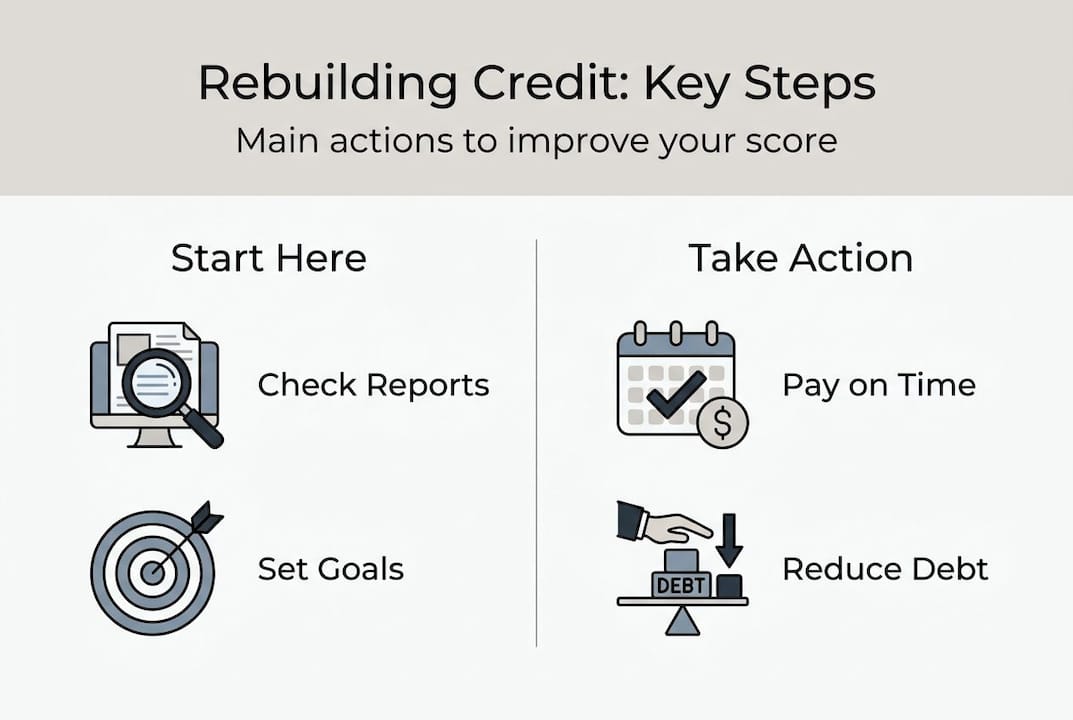
- Pay every bill on time. Payment history makes up 35% of your FICO score. Set up autopay for at least the minimum payment on every account so you never miss a due date.
- Reduce your credit card balances. Keeping your utilization below 30% is the rule, but below 10% is where the real score gains happen. If you have a $1,000 limit, keep the balance under $100.
- Dispute any errors on your reports. Wrong information is not your debt to carry. File disputes and follow up.
- Open a secured credit card. If you can’t qualify for a regular card, a secured card requires a deposit and reports to the bureaus just like a regular card. Use it for small purchases and pay it off monthly.
- Become an authorized user. Ask a family member with good credit to add you to their account. Their positive history can reflect on your report.
- Use Experian Boost. This free tool lets you add on-time utility and streaming payments to your Experian credit file, which can give your score a small but real lift.
- Avoid new credit applications during rebuilding. Each hard inquiry can drop your score by a few points. Wait until you’ve stabilized before applying for new accounts.
For business owners specifically: pay your vendors early when possible, because early payments are what push a PAYDEX score toward 80 or above. Use credit repair tricks that apply to business tradelines too.
“The most reliable path to a higher score is boring on purpose: pay on time, keep balances low, and let time do its work.”
Here’s a comparison of two common approaches:
| Approach | Time to see results | Risk level | Effectiveness |
|---|---|---|---|
| Consistent on-time payments | 3 to 6 months | Low | High |
| Credit repair companies | Varies | Medium | Varies |
| “Credit hacks” or loopholes | Minimal | High | Low |
| Secured card + low utilization | 6 to 12 months | Low | High |
Pro Tip: Set your credit card to autopay the full balance each month. You build payment history without paying a cent in interest, which is the cleanest way to improve your score.
Looking at future credit repair strategies can also help you plan beyond the immediate rebuilding phase.
Verification: Monitoring progress and avoiding setbacks
You’ve started building better habits. Now you need to protect that progress. Monitoring your score regularly keeps you motivated and helps you catch problems before they spiral.
Here’s how to stay on track:
- Use free monitoring tools. Many banks and credit card issuers offer free monthly score updates. Apps like Credit Karma also give you free access to your TransUnion and Equifax scores.
- Schedule quarterly report checks. Pull your full reports from AnnualCreditReport.com every 90 days to review for new errors or unexpected changes.
- Watch for hard inquiries. If you see an inquiry you didn’t authorize, that’s a red flag for potential fraud.
- Track your utilization monthly. Even if you pay on time, a high balance at the time your statement closes can hurt your score.
Understanding the timeline for negative items helps too. Late payments stay on your report for seven years, and a Chapter 7 bankruptcy stays for ten years. But here’s the important part: their impact fades significantly over time, especially once you build up consistent positive history on top of them.
The most common setbacks people face during rebuilding:
- Missing a single payment after months of progress
- Applying for multiple new cards or loans at once
- Closing old accounts, which shortens your credit history
- Letting a balance creep back up after paying it down
Pro Tip: If you’re worried about overspending on a credit card, set a low credit limit on your secured card. A $300 limit is enough to build history without the risk of running up a balance you can’t pay.
Learning about avoiding credit declines and applying easy credit repair tricks consistently is what separates people who rebuild successfully from those who stall out.
Our perspective: What really works to rebuild credit
After working with individuals and small business owners across all kinds of credit situations, one truth stands out: the people who rebuild fastest are not the ones who found a clever trick. They’re the ones who stopped looking for shortcuts and committed to boring, consistent habits.
Debit cards and prepaid cards feel like responsible spending, but they do nothing for your score because they don’t report to credit bureaus. A lot of people spend years using these tools thinking they’re building credit, and they’re not.
For small business owners with a personal FICO below 650, the right move is to focus on personal credit first. Trying to build business credit on a weak personal foundation is like building a house without a floor. Lenders will still check your personal score, and a low number will block you regardless of your PAYDEX.
Impatience is the biggest threat to any credit rebuilding plan. We’ve seen people make real progress over six months and then blow it by applying for five new cards at once. Stick to the fundamentals, track your repairing credit ratings, and trust the process.
Next steps: Get expert help and proven tools for credit rebuilding
If you’re ready to take the next step, professional guidance and smart tools can accelerate your progress.
Credit Rebooter offers a full range of resources designed specifically for people in your situation. Whether you’re just starting out or trying to break through a plateau, our credit building strategies give you a clear, personalized roadmap.

Before you sign up with any credit repair service, make sure you understand the process. Our guide on warning credit repair helps you avoid common scams and know what legitimate help looks like. When you’re ready to take action, explore our credit score repair services to see how we can work with you directly to reach your financial goals faster and smarter.
Frequently asked questions
How long does it take to rebuild credit after negative items?
Late payments remain on your report for seven years and Chapter 7 bankruptcy for ten, but their impact fades steadily as you build positive history on top of them.
Will using a debit or prepaid card help rebuild my credit?
No. Debit and prepaid cards do not report to credit bureaus, so they have no effect on your score regardless of how responsibly you use them.
What’s the minimum credit score needed for a home loan?
FHA loans require a minimum score of 580, while conventional mortgages typically require at least 620 to qualify.
Are personal and business credit scores separate?
Yes, they are tracked separately, but for small business owners, both scores matter because lenders often review your personal credit as part of any business loan application.
What is the fastest way to see improvement in my credit score?
Paying every bill on time and reducing utilization below 30%, ideally under 10%, produces the fastest and most reliable score improvements.