You’re sitting across from a loan officer, ready to buy the home you’ve been saving for, and then the number on the screen changes everything. Your credit score determines your interest rate, your approval odds, and sometimes whether you get the keys at all. Good credit isn’t something you set up once and forget. It’s a living, breathing part of your financial life that rewards consistent habits and punishes even small slip-ups. This guide walks you through exactly what to do, in what order, and why it matters so much for every major financial milestone ahead of you.
Table of Contents
- What affects your credit score: The essentials
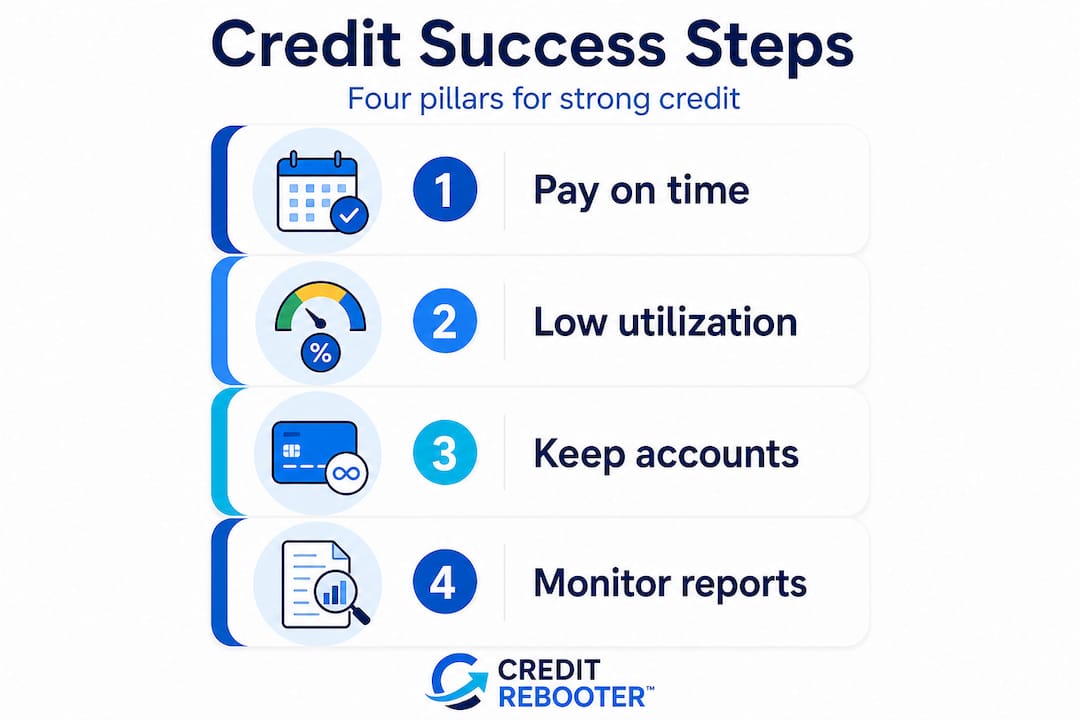
- Step 1: Pay every bill on time—no exceptions
- Step 2: Master your credit utilization ratio
- Step 3: Build and preserve a healthy credit history
- Step 4: Monitor and protect your credit file
- The hard truths and hidden shortcuts of credit maintenance
- Take control of your credit journey with expert help
- Frequently asked questions
Key Takeaways
| Point | Details |
|---|---|
| Prioritize on-time payments | Never miss due dates, as late payments heavily damage your score. |
| Keep credit utilization low | Aim for under 30%, ideally below 10%, for best results. |
| Build long-term credit habits | Preserve older accounts, avoid too many new inquiries, and monitor reports regularly. |
| Dispute only acccurate errors | Only challenge credit report inaccuracies, since true negatives will fade in impact with time. |
| Knowledge is protection | Regularly checking reports defends against surprises and gives you actionable insights. |
What affects your credit score: The essentials
Knowing what influences your credit score is the first step before making changes, so let’s break down the essentials.
Your credit score is calculated using five distinct factors, each carrying a different weight. Understanding those weights helps you prioritize your energy and avoid chasing improvements in areas that matter least.
| Factor | Weight | What it measures |
|---|---|---|
| Payment history | 35% | Whether you pay on time |
| Credit utilization | 30% | How much of your credit you use |
| Length of credit history | 15% | Age of your accounts |
| Credit mix | 10% | Variety of account types |
| New credit | 10% | Recent applications and inquiries |
The FICO score breakdown makes it clear: payment history alone drives more than a third of your score. Miss enough payments and no other strategy will save you. The second biggest piece, credit utilization, accounts for 30% of your FICO score and rewards those who borrow responsibly. Together, these two factors control 65% of your score.
The remaining 35% breaks down as follows, according to what affects credit scores: length of credit history at 15%, credit mix at 10%, and new credit at 10%. These factors matter, but they’re secondary. Here’s what that means in practice:
- Payment history: Even one missed payment can do serious damage
- Utilization: High balances relative to your limits hurt you, even if you pay on time
- History length: Closing old accounts shortens your average account age
- Credit mix: Having both revolving credit (cards) and installment loans (auto, mortgage) helps
- New credit: Too many applications in a short window signals risk to lenders
Focus on the top two pillars first. Everything else follows naturally when those are locked in.
Step 1: Pay every bill on time—no exceptions
Payment history is the heaviest factor, so here’s how to ace it.
Most people understand that late payments are bad. What many don’t realize is how fast the damage hits. A single 30-day late payment can drop your score by 60 to 110 points depending on where you start. If you’re sitting at 740, one missed payment could shove you down into a range that costs you a better mortgage rate.
The good news is that payment history rewards consistency just as hard as it punishes failure. Build a long track record of on-time payments and your score becomes nearly bulletproof over time.
Here are four practical steps to make sure you never miss a due date:
- Set up autopay for every recurring bill. This includes credit cards, utilities, and loan payments. Even setting autopay for the minimum payment protects your credit record, though paying in full is always the goal.
- Create calendar reminders three days before each due date. This gives you time to move funds if needed before autopay kicks in.
- Consolidate due dates. Contact your card issuers and request that all cards share the same due date. Managing one deadline is far easier than tracking five.
- Review your accounts weekly. Fraudulent charges can push your balance over the limit or disrupt autopay. Catching problems early keeps everything on track.
“The best credit builders we see at Credit Rebooter are almost always people who treat payment dates like non-negotiable appointments. They don’t rely on memory alone. They build systems.”
Pro Tip: If you’re starting fresh and worried about avoiding bad credit, begin with just one credit card tied to autopay. A single account paid on time, every time, does more for your credit history than five accounts managed carelessly.
Late payment damage fades over time, but it stays on your report for seven years. That’s seven years of a number you’re explaining to lenders, landlords, and even employers who check credit. Don’t let one forgetful week cost you nearly a decade of credibility.
Step 2: Master your credit utilization ratio
On-time payments are essential, but utilization is nearly as impactful. Here’s how to get it right.

Your credit utilization ratio (also called your utilization rate) is the percentage of your total available revolving credit that you’re currently using. The math is simple: if you have $10,000 in total credit limits across all your cards and carry $3,000 in balances, your utilization is 30%.
According to credit utilization guidance, you should keep utilization under 30%, but the people with the highest scores typically stay below 10%. That means on a $10,000 credit limit, your ideal total balance is $1,000 or less when your statements close.
Here’s a comparison of how utilization ranges tend to affect your credit profile:
| Utilization range | Score impact | What lenders see |
|---|---|---|
| 0–10% | Best | Highly responsible borrower |
| 11–29% | Good | Manageable debt level |
| 30–49% | Fair | Approaching risk threshold |
| 50–74% | Poor | Over-reliance on credit |
| 75%+ | Very poor | High default risk signal |
A key insight that many people miss: your utilization is calculated based on the balance reported to the bureaus, which usually happens on your statement closing date, not your payment due date. Paying down revolving debt before your statement closes means a lower balance gets reported, which directly improves your score even if you pay everything off afterward.
Practical ways to lower your utilization quickly:
- Make an extra payment mid-cycle to reduce your reported balance before the statement date
- Request a credit limit increase on existing cards (without spending more)
- Spread purchases across multiple cards rather than maxing out one
- Avoid closing paid-off cards since that reduces your total available credit and raises utilization instantly
Understanding these nuances is exactly the kind of thing covered in credit building strategies that actually move the needle. If you want a deeper dive on specific tactics, explore how to improve your credit score for more detailed frameworks.
Pro Tip: If you get a large bill you can’t pay off immediately, call your card issuer before the statement closes and make a partial payment. Reducing the reported balance by even a few hundred dollars can visibly improve your utilization score that same month.
Step 3: Build and preserve a healthy credit history
Maintaining what you’ve built is just as important as building it. Here’s how to keep your credit portfolio strong.
Credit history length represents 15% of your score, and the best thing you can do for it is simply not interfere. Every old account you keep open, even if you barely use it, adds to your average account age. Close that 10-year-old store card because you never use it anymore and you’ve just cut years off your credit age.
Factors affecting credit scores confirm that longer histories build more lender trust, everything else being equal. A credit file with accounts averaging 8 years old tells a very different story than one averaging 2 years.
Here’s how to protect and grow your credit history deliberately:
- Keep your oldest accounts open and active. Use them for a small recurring purchase, like a streaming subscription, and pay it off monthly
- Avoid applying for multiple new accounts in a short window. Each application triggers a hard inquiry that temporarily dips your score
- Rate shop within a focused time frame. When comparing mortgage or auto loan rates, limit inquiries to a 14 to 45 day window so they count as a single inquiry
- Use secured credit cards if you’re rebuilding. These require a deposit and report to the bureaus just like regular cards
- Consider a credit-builder loan from a credit union or community bank. Your payments get reported monthly and build history without needing existing credit
USA.gov’s credit guidance specifically advises against closing old accounts, because doing so harms both history length and your total available credit. It’s one of the most common mistakes well-meaning people make.
If you’re starting from scratch or recovering from past issues, check out resources on building credit history and specialized student credit repair solutions that address thin or damaged files with proven, practical approaches.
Step 4: Monitor and protect your credit file
Even perfect habits won’t help if errors drag you down. Here’s how to stay vigilant and fix mistakes early.
Errors on credit reports are more common than most people realize. A wrong account balance, a payment misreported as late, or a fraudulent account opened in your name can all silently drain your score while you continue doing everything right.
The FTC advises that you check your credit reports at AnnualCreditReport.com regularly, and under the Fair Credit Reporting Act (FCRA), you have the legal right to dispute inaccurate information. Bureaus must investigate and respond within 30 days.
Here’s a simple process for reviewing and protecting your file:
- Pull your reports from all three bureaus (Equifax, Experian, and TransUnion) at AnnualCreditReport.com. They’re free, and weekly access is now available.
- Check each account for accuracy. Look for accounts you don’t recognize, incorrect balances, payments marked late when they were on time, and duplicate entries.
- File a dispute directly with the bureau that shows the error. Provide documentation like bank statements or payment confirmations to support your claim.
- Follow up within 30 days. Bureaus are required to investigate, but staying on top of the process ensures nothing falls through the cracks.
Pro Tip: Stagger your bureau checks every four months. Pull Equifax in January, Experian in May, and TransUnion in September. This gives you nearly continuous monitoring throughout the year at no cost.
Negative information, including late payments, stays on your report for 7 years, and bankruptcies can remain for 10. But here’s the critical distinction: only dispute inaccurate information. Accurate negative marks, even painful ones, cannot be legally removed before they age off naturally. Their impact, however, does fade significantly over time as positive history builds around them.
For more targeted advice on this process, tips on how to improve your credit score cover the nuances of dealing with bureaus and tracking progress over time.
The hard truths and hidden shortcuts of credit maintenance
Standard guides walk you through the steps. What they often leave out is the real-world behavior that separates people who maintain strong scores from those who keep starting over.
Here’s a pattern we see constantly: someone pays off a credit card balance, feels a surge of pride, and immediately closes the account. It feels financially responsible. In reality, it just reduced their available credit, raised their utilization ratio, and shortened their average account age, often all in one move. That single “good” decision can knock 20 to 40 points off a score overnight.
Another trap is what we call the application spiral. Someone sees an offer for a new rewards card, applies, gets approved, and then applies for another a few months later. Each application costs a few points, opens a new account that lowers average age, and tempts higher spending. Over time, this pattern erodes the score it was supposed to build.
The contrarian truth we’ve seen hold up repeatedly: sometimes doing nothing is the right move. Keeping that paid-off store card open with a zero balance, skipping the shiny new rewards offer, and simply letting old accounts age quietly is often more powerful than any aggressive action you could take.
The other thing most guides won’t tell you is that the biggest short-term score boosts, like paying down a high balance or getting added as an authorized user on someone else’s old account, are real and fast-acting. But they are not substitutes for the long-term discipline of consistent payments and low utilization month after month. Think of short-term tactics as accelerators, not engines.
We’ve helped thousands of people work through exactly these patterns at Credit Rebooter, and the ones who succeed long-term are the ones who stop looking for hacks and start building reliable systems instead.
Take control of your credit journey with expert help
Understanding the steps is one thing. Having the right tools and support to execute them, month after month, is where most people benefit from guidance.

At Credit Rebooter, we work with real people navigating real credit challenges, from recovering after financial setbacks to preparing for major purchases. Whether you’re looking for credit score repair after a rough patch, focused credit building strategies to strengthen your file, or bad credit repair support to address deeper issues, our resources and personalized assistance are built to move you forward. You don’t have to figure all of this out alone. The right next step is just a click away.
Frequently asked questions
How often should I check my credit report?
You should check your credit report at least once a year, but free weekly access at AnnualCreditReport.com makes more frequent monitoring practical and worthwhile for catching errors early.
Is it better to pay off all debt or keep small balances?
Paying off your balances in full is always the better move. Carrying a small balance does not help your score, and it costs you unnecessary interest.
What happens if I miss a payment by a few days?
Creditors typically don’t report a payment as late until it’s at least 30 days past due, but a 30-day late mark can drop your score significantly, so catching it early is critical.
Does opening new credit always hurt my score?
Opening new credit causes a small temporary dip, but rate shopping within 14 to 45 days for the same type of loan typically counts as a single inquiry rather than multiple.
How long does negative information stay on my credit report?
Most negative marks remain for 7 years, while bankruptcies can stay for 10, though their influence on your score lessens considerably as time passes and positive history grows.