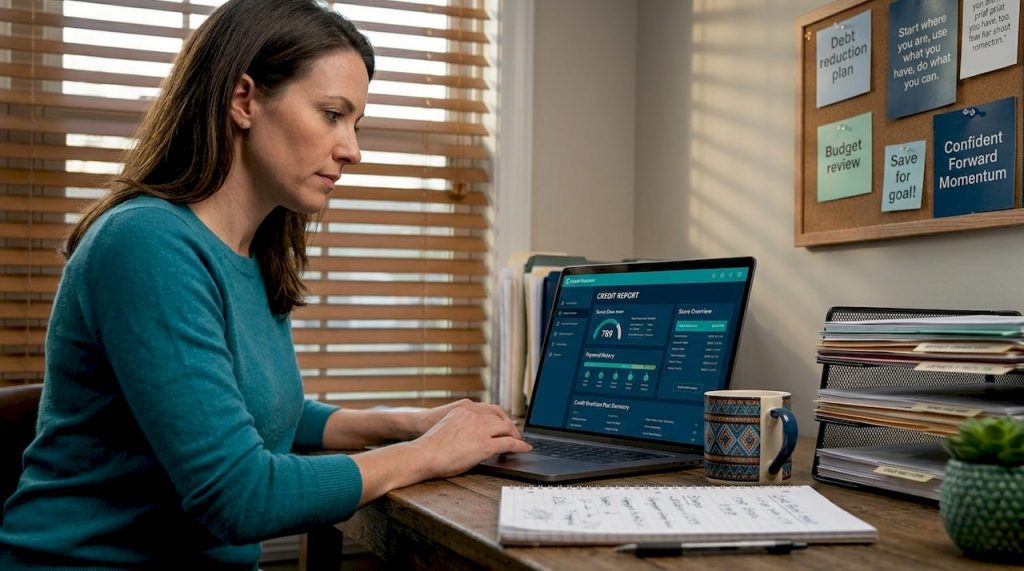
One in five people carry errors on their credit reports right now, and most of them have no idea. Those mistakes can quietly cost you loan approvals, higher interest rates, and even job opportunities. Whether you’re trying to buy a home, eliminate debt, or secure funding for your small business, your credit score is the number that opens or closes doors. This article gives you evidence-backed, step-by-step credit repair tips that actually work, written for real people navigating real financial goals.
Table of Contents
- Start with your credit report: Identify and fix errors
- Lower your credit utilization for a quick score boost
- Handle negatives and avoid credit repair scams
- Actionable tips for small business owners
- How do different credit repair tips compare?
- The uncomfortable truth: Why slow and steady credit repair really wins
- Need tailored help? Try Credit Rebooter’s expert solutions
- Frequently asked questions
Key Takeaways
| Point | Details |
|---|---|
| Check and fix errors | Review your credit reports for mistakes and dispute them for the fastest score increases. |
| Lower utilization | Reduce your credit utilization below 7% to gain 20–50 points quickly. |
| DIY over companies | Do your own disputes—it’s free and safer than paying for risky credit repair services. |
| Mind business credit | Business owners should separate and monitor both personal and business credit for full financial health. |
| Be patient | Accurate negative marks fade with time; steady progress brings lasting improvements. |
Start with your credit report: Identify and fix errors
The first move in any credit repair plan is pulling your report and reading every line. You’d be surprised how many people skip this step and go straight to paying off debt, only to miss the fact that a collection account that isn’t even theirs is dragging down their score.
You can get free credit reports every week from AnnualCreditReport.com. Request your reports from all three major bureaus: Experian, Equifax, and TransUnion. Each bureau can carry different data, so checking all three is non-negotiable.
Here’s how to review your report effectively:
- Check for accounts you don’t recognize. Identity theft and mixed files (where another person’s data appears on your report) are more common than you’d think.
- Verify balances and payment history. Creditors sometimes report a late payment when the payment was actually on time. Every inaccuracy matters.
- Look for duplicate collection accounts. A single debt sometimes gets sold and re-reported multiple times, artificially inflating your negative marks.
- Confirm that closed accounts are marked closed. An account showing as “open” when it’s been closed can affect your available credit calculation.
- Check personal information. Wrong addresses or name variations can indicate mixed files that need to be corrected.
Once you find an error, dispute it in writing. Send your dispute letter with supporting documents (bank statements, payment confirmations, correspondence) directly to the bureau reporting the error. Under the Fair Credit Reporting Act (FCRA), a federal law protecting your right to accurate reporting, bureaus must investigate within 30 days of receiving your dispute. If the investigation confirms the error, the item must be corrected or removed. Successful disputes can raise your score by 25 to 100 points, depending on the severity of what was removed.
Pro Tip: Send dispute letters via certified mail with return receipt. This creates a paper trail that protects you legally if the bureau fails to respond within the required timeframe.
Getting serious about fixing your credit score starts here because removing inaccurate negatives is the only way to get a clean baseline for everything else you build on top.

Lower your credit utilization for a quick score boost
After cleaning up errors, the fastest lever you can pull is your credit utilization ratio. This is simply the percentage of your available revolving credit (credit cards, lines of credit) that you’re currently using.
The math is straightforward. If your credit limit is $10,000 and your balance is $3,000, your utilization is 30%. Most people know that staying under 30% is good. But here’s what most people don’t know: reducing utilization below 7% can boost your score by 20 to 50 points.
| Utilization rate | Score impact | Notes |
|---|---|---|
| Above 50% | Very negative | Signals high credit risk |
| 30% to 49% | Moderate negative | Common advice is to stay below this |
| 10% to 29% | Neutral to slightly positive | Acceptable but not optimal |
| 1% to 9% | Strongest positive boost | Ideal target range for score maximizing |
| 0% (no balance) | Slightly less effective | Activity shows you use credit responsibly |
Here are proven ways to improve your utilization right now:
- Pay down high-balance cards first. Focus extra payments on cards closest to their limits before spreading payments across all cards.
- Request a credit limit increase. If you’ve been a consistent, on-time payer, call your card issuer and ask for a higher limit. Same balance, higher limit equals lower utilization instantly.
- Spread balances across cards. Instead of maxing one card, distribute spending so no single card crosses the danger zone.
- Make a mid-cycle payment. Card issuers report your balance on a specific date each month. Paying before that date reduces the balance that gets reported.
- Open a new credit account strategically. Adding a new account increases your total available credit, but only do this if you’re disciplined enough not to carry new balances.
Pro Tip: Time your big payments to land at least five days before your statement closing date. That’s the date your card issuer typically reports your balance to the bureaus, not your payment due date.
Learning to improve credit utilization and using smart credit building strategies together can create a compounding effect on your score that errors alone would never achieve.
Handle negatives and avoid credit repair scams
Here’s the uncomfortable reality about negative items on your credit report: if they’re accurate, nobody can remove them early. Not you, not a credit repair company, not a lawyer. Accurate late payments stay on your report for seven years. Bankruptcies stick around for ten years. These timelines are set by federal law.
What you can challenge is inaccurate or unverifiable information. That’s where legitimate credit repair work lives. Understanding this boundary protects you from one of the most predatory industries in personal finance.
“Credit repair companies cannot remove accurate, current negative information from your credit report. Anyone who claims they can do this is lying to you. You can dispute errors yourself, for free, directly with the credit bureaus.” Source: FTC consumer alert on credit repair scams
Watch out for these red flags that signal a scam:
- Demands for upfront fees before any work is done. Under federal law, credit repair companies cannot collect payment before completing the services they promised.
- Promises to remove accurate negatives or wipe your credit history clean. This is illegal and impossible.
- Offers to create a “new credit identity.” This involves applying for an Employer Identification Number (EIN) to use instead of your Social Security number, which is federal fraud.
- Discouraging you from contacting credit bureaus directly. Legitimate advisors empower you to act. Scammers want to keep you dependent and paying.
- Pressure tactics and urgency. Phrases like “limited time offer” or “we guarantee results” are warning signs, not selling points.
The DIY credit repair tricks approach is not only cheaper but also more sustainable. When you dispute and manage your own credit, you learn exactly what affects your score and how to maintain improvements long-term. That knowledge protects you from future mistakes too.
Actionable tips for small business owners
If you run a small business or have a side hustle, your credit repair plan has an extra dimension. Your personal credit score directly affects your business financing options, and building business credit separately is a smart long-term move that most small business owners overlook until they’re sitting in front of a lender with no credit history to show.
Start with these steps:
- Get an EIN (Employer Identification Number) from the IRS. This separates your business identity from your personal Social Security number and is required to open business bank accounts and apply for business credit.
- Open a dedicated business bank account and business credit card. Mixing personal and business finances is the number one mistake that derails small business credit building. Keep them completely separate.
- Apply for a DUNS number from Dun & Bradstreet. This is the business world’s equivalent of a Social Security number. Lenders and vendors use it to look up your business credit profile.
- Work with vendors and suppliers who report payment activity. Not every vendor reports to business credit bureaus. Prioritize vendors who report to Dun & Bradstreet or Experian Business.
- Pay every business invoice early or on time. Business credit scoring often rewards early payment more aggressively than personal credit scoring does. Net-30 terms paid in 10 days can accelerate your business credit profile quickly.
- Monitor your business credit reports regularly. Check Experian Business and D&B’s Paydex score for errors just like you would your personal reports.
Here’s a comparison of personal and business credit requirements for common financing goals:
| Goal | Personal credit requirement | Business credit requirement |
|---|---|---|
| SBA loan | Personal FICO 650+ typically required | Business credit profile reviewed but not always scored |
| Business credit card | Personal score used for approval | Business credit builds after approval and use |
| Commercial lease | Personal guarantee often required | Business credit history may reduce required deposit |
| Equipment financing | Personal credit reviewed | Strong business credit can reduce personal guarantee |
| Business line of credit | 680+ personal FICO often preferred | Established business credit speeds approval |
Your personal FICO score remains essential for SBA loans, most small business loans from community banks, and almost any financing during your first two years of operation. Aim for 650 minimum, but a score of 720 or above puts you in a much stronger negotiating position.
Following the right steps to credit repair on the personal side while building business credit simultaneously gives small business owners the strongest possible foundation for growth.
How do different credit repair tips compare?
To help you decide where to spend your energy first, here’s a side-by-side comparison of the most effective credit repair actions, including realistic timeframes, point potential, and the effort each one requires.
| Strategy | Timeframe to results | Potential score increase | Effort level | Cost |
|---|---|---|---|---|
| Disputing report errors | 30 to 45 days | 25 to 100+ points | Medium | Free |
| Reducing utilization below 7% | 30 to 60 days | 20 to 50 points | Low to medium | Free |
| On-time payment history | 6 to 12 months | 20 to 40 points | Low | Free |
| Adding a secured credit card | 3 to 6 months | 10 to 30 points | Low | Minimal deposit |
| Building business credit | 6 to 24 months | Separate score | Medium to high | Low |
| Avoiding new hard inquiries | Ongoing | Prevents 5 to 10 pt losses | Low | Free |
As the data shows, disputes can increase scores by 25 to 100 points, making error correction the highest-leverage action available. Utilization reduction is the fastest strategy because it responds to real-time balance changes, not aging data.
For anyone focused on improving your credit score on a tight timeline, combining dispute resolution with utilization management is your best double play.
The uncomfortable truth: Why slow and steady credit repair really wins
There’s a version of credit repair advice that gets passed around constantly, and it involves tricks, loopholes, and rapid-result promises. We’ve seen it all. Here’s what we actually know after working with individuals and small business owners who have gone through the process the right way and the wrong way.
The people who achieve lasting score improvements are almost universally the ones who chose boring, deliberate habits over exciting shortcuts. They pulled their reports, sent dispute letters, paid balances down methodically, and waited. And waiting is the part nobody wants to hear.
Accurate negative marks take time to fade because that’s exactly how the system was designed. A late payment from three years ago has less impact on your score today than it did when it was fresh. Time working in your favor is a real, documented phenomenon, and you cannot speed it up by disputing accurate information or paying someone to “negotiate” its removal.
What the quick-fix mindset actually costs people is far more than money. It costs them credit inquiries from multiple applications. It costs them the opportunity cost of paying a credit repair company hundreds of dollars monthly for something they could do themselves for free. Sometimes it costs them federal fraud charges when they unknowingly participate in file segregation schemes.
The honest framework is this: control the controllables. Dispute errors. Reduce utilization. Pay on time, every time. Keep old accounts open. Use tips on how to improve your credit score that are grounded in how credit scoring models actually work, not in what some company promises. Every point you build through legitimate means is a point that stays.
The people who reach their goal of buying a home or qualifying for a business loan are the ones who treated credit repair like a long game with clear rules, not a puzzle with hidden shortcuts.
Need tailored help? Try Credit Rebooter’s expert solutions
If you’ve tackled the basics and still feel stuck, or if your situation involves multiple negatives, high utilization across several accounts, or a business credit profile that needs rebuilding from scratch, having structured guidance changes the outcome.

Credit Rebooter offers personalized tools and expert support for both individuals and small business owners who need more than a checklist. Whether you need bad credit repair help to address serious derogatory marks, want to follow proven credit building strategies with a clear roadmap, or need comprehensive credit score repair that covers every factor affecting your score, the platform connects you with resources built specifically for your situation. Register for free and access the learning center, personalized recommendations, and step-by-step support designed to move your score toward your goals.
Frequently asked questions
How quickly can I improve my credit score with these tips?
Many people see measurable results within 30 days after disputing errors or paying down card balances, since credit bureaus must respond to disputes within that window, though some improvements take several months to fully reflect.
Is it worth paying a credit repair company?
No. Credit repair companies cannot remove accurate negative information, and everything a paid service does is something you can do yourself for free directly with the credit bureaus.
Does closing old credit cards help my credit score?
Closing old cards usually hurts your score by reducing your available credit and increasing your utilization ratio. Keep older accounts open and use them occasionally to maintain the credit history they provide.
What is considered a good credit utilization ratio?
Keeping your utilization below 7% offers the strongest score impact, with research showing this threshold delivers a 20 to 50 point increase compared to higher utilization rates.
How can business owners protect their personal credit?
Keep personal and business finances completely separate with an EIN and dedicated business accounts, and maintain a personal FICO above 650 since most SBA loans and small business financing programs rely on your personal score for approval decisions.