
Many people hand over hundreds of dollars to credit repair companies expecting a spotless report within weeks. The pitch is convincing, the urgency is real, and the financial stakes feel enormous. But most of what you’ve heard about credit repair is either exaggerated, misleading, or flat-out wrong. Falling for these myths doesn’t just cost money; it can actively damage your score and delay the financial goals that matter most to you, whether that’s buying a home, securing a business loan, or finally getting approved without a cosigner. This guide cuts through the noise.
Table of Contents
- Separating fact from fiction: What credit repair really means
- Top 5 credit repair myths debunked with facts
- Understanding how credit scores really work
- Credit repair tips for individuals and business owners
- How long does negative information really stay on your report?
- Expert perspective: Why most people still fall for credit repair myths
- Take the next step toward real credit repair
- Frequently asked questions
Key Takeaways
| Point | Details |
|---|---|
| Credit repair is not instant | Fixing your credit score takes time and consistent positive habits—not quick fixes. |
| DIY credit repair is possible | You can dispute errors on your credit report for free without hiring a company. |
| Myths can hurt your score | Believing and acting on common credit myths can actually damage your credit health. |
| Separate personal and business credit | Business owners should know that personal and business credit reports and repair strategies are different. |
| Negative marks have timelines | Most negative information stays for up to 7 years, but some, like bankruptcies, last up to 10 years. |
Separating fact from fiction: What credit repair really means
Let’s start by defining what credit repair actually is, and why most people have the wrong idea.
“Credit repair” and “credit improvement” sound interchangeable, but they describe very different things. Credit repair refers specifically to identifying and disputing inaccurate or outdated information on your credit report. Credit improvement is the broader, ongoing process of building better financial habits over time. Confusing the two is where most people go wrong.
Here’s the core truth: credit repair companies cannot legally remove accurate and up-to-date negative information from your credit report. Period. If you missed three payments in 2023, no company on earth can make that disappear before the legal timeframe is up. Anyone promising otherwise is either lying or planning to use tactics that could get you in serious trouble.
Under the Fair Credit Reporting Act (FCRA), which is the federal law governing credit reporting, you have the legal right to dispute errors at no cost. The bureaus, Equifax, Experian, and TransUnion, must investigate disputes within 30 days. If the information can’t be verified, it gets removed. That’s the legitimate version of credit repair.
Common red flags from credit repair scams:
- They promise to remove accurate negative items
- They ask for payment upfront before doing any work
- They tell you to dispute everything, even accurate information
- They suggest creating a “new” credit identity using an Employer Identification Number (EIN)
- They discourage you from contacting credit bureaus directly
Before you pay anyone a single dollar, review the common credit repair assumptions that trip people up. You might realize you don’t need a paid service at all.
| Legitimate credit repair | Credit repair scams |
|---|---|
| Disputing verified errors under FCRA | Promising to remove accurate negatives |
| Transparent pricing with CROA compliance | Demanding upfront fees before work |
| Encouraging direct bureau contact | Telling you to avoid the bureaus |
| Setting realistic timelines | Guaranteeing results in days or weeks |
“The only legal way to remove negative information from your credit report before its natural expiration is to prove it is inaccurate or unverifiable.”
Top 5 credit repair myths debunked with facts
With the basics covered, let’s look at the biggest myths keeping people from repairing their credit effectively.
Myth 1: Paid companies can remove accurate negative items
This is the most dangerous myth in the industry. If you paid a bill late, defaulted on a loan, or had an account sent to collections, that information is accurate. No company can force a bureau to remove it. What a legitimate service can do is help you identify errors, which is something you can also do yourself. You’re not helpless here.
Myth 2: You need professionals to dispute errors
Individuals can dispute errors for free themselves, without needing a credit repair company. The process involves pulling your credit reports, identifying the error, submitting a written dispute with supporting documentation, and waiting for the bureau’s investigation. It takes effort, but it’s entirely doable. Start with improving your credit score tips to understand what to look for in your report.
Myth 3: Checking your own credit hurts your score
This one keeps people in the dark for years. Checking your own report is classified as a “soft inquiry” and has zero impact on your score. It’s lender-initiated “hard inquiries” (like applying for a credit card or mortgage) that create a small, temporary dip. Check your report as often as you want. In fact, checking it regularly is one of the smartest moves you can make.
Myth 4: Closing old accounts will help your score
Intuition says fewer accounts means less risk. The math says otherwise. Closing old accounts reduces your total available credit limit, which increases your credit utilization ratio. It also shortens your average account age. Both of these changes push your score down. Unless an account has a high annual fee or tempts you to overspend, leave it open.

Myth 5: Credit repair is instant
Credit repair is not a quick fix; it takes months of consistent positive behavior like on-time payments and low utilization to produce meaningful results. Even verified errors that are successfully removed might only shift your score incrementally if other negative factors are still present. Real improvement requires a sustained strategy, not a one-time fix.
Pro Tip: Use credit repair tricks that focus on building positive history rather than trying to erase the past. New good behavior gradually outweighs old negative marks.
Understanding how credit scores really work
After debunking the myths, it’s important to understand how credit scores are really determined.
Your FICO score, the most widely used credit scoring model, breaks down into five weighted factors. Understanding these factors helps you prioritize what to fix first.
| Credit score factor | Weight | What it means |
|---|---|---|
| Payment history | 35% | On-time vs. late payments |
| Credit utilization | 30% | Balance relative to credit limit |
| Length of credit history | 15% | Age of oldest, newest, and average accounts |
| Credit mix | 10% | Variety of credit types (cards, loans, mortgage) |
| New credit inquiries | 10% | Recent hard pulls from applications |
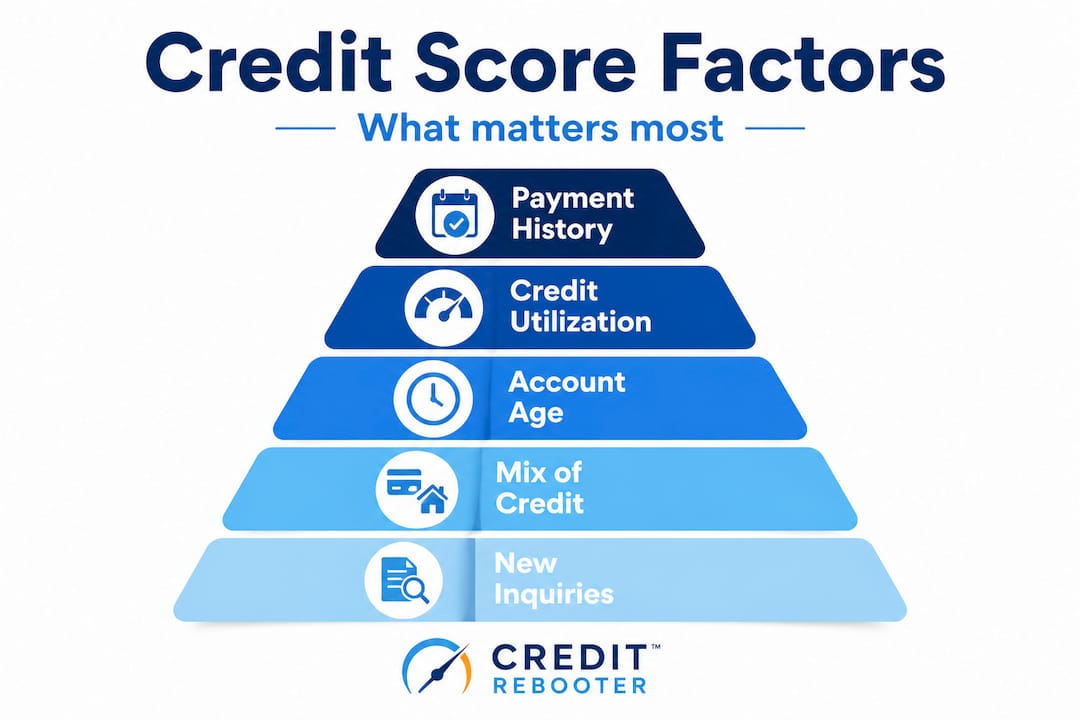
Payment history is the single biggest factor, which is why one missed payment causes so much damage. A late payment can drop your score by 60 to 110 points, depending on where you started. Someone with an 800 score loses more points from a single late payment than someone with a 600, because lenders see it as more out of character.
Credit utilization is the most instantly adjustable factor. Keeping it under 30%, ideally lower, gives you a significant advantage. If you carry a $5,000 balance on a card with a $10,000 limit, your utilization is 50%, which is hurting you. Pay it down to under $1,500 and watch your score improve within one to two billing cycles.
Here’s what most people miss about length of credit history: every time you close an old account or open a new one, you shift your average account age. Opening five new cards to “build credit faster” actually pulls your average age down and triggers five hard inquiries. That’s a double hit.
Key behaviors that move the needle:
- Paying every bill on time, even the minimum
- Keeping card balances below 30% of the limit
- Keeping old accounts open even if unused
- Avoiding multiple credit applications at once
- Disputing verified errors promptly
For a step-by-step approach, review effective credit improvement steps to create a realistic plan. Also look at repair and build credit solutions if you’re starting from a low score.
Pro Tip: Set up autopay for at least the minimum payment on every account. One forgotten bill can wipe out months of progress. Automation removes the human error from the equation.
Credit repair tips for individuals and business owners
Now that you understand the mechanics, let’s put them into action with tips tailored for both individuals and small business owners.
Personal credit and business credit are related, but they function differently. For small business owners, personal and business credit are separate; personal guarantees often link them initially, but business credit must be built via trade lines reporting to Dun & Bradstreet, Experian Business, and similar bureaus. Many business owners don’t realize they need to actively build a business credit profile, it doesn’t happen automatically just because you form an LLC or corporation.
For individuals repairing personal credit:
- Pull all three credit reports from AnnualCreditReport.com and compare them
- Dispute any errors in writing with documentation, not just online forms
- Become an authorized user on a trusted family member’s well-managed account
- Apply for a secured credit card if your score is under 600
- Request goodwill adjustments from creditors for isolated late payments with a clean track record
- Keep utilization under 30% across all cards and under 10% on individual cards
For small business owners building business credit:
- Incorporate your business and get an EIN if you haven’t already
- Open a dedicated business checking account and keep it active
- Apply for a DUNS number through Dun & Bradstreet (it’s free)
- Establish trade lines with vendors who report to business credit bureaus
- Apply for a small business credit card and pay it in full each month
- Keep personal guarantees minimal as your business profile strengthens
If your personal score is under 650, start with repairing credit essentials to understand which actions give you the fastest legitimate results. Secured cards, credit-builder loans, and on-time rent reporting (through services like Experian Boost) can move a low score faster than disputing items that are simply old but accurate.
How long does negative information really stay on your report?
Finally, let’s set the record straight on how long credit issues actually follow you and what you can do about them.
This is where a lot of people feel hopeless, and unnecessarily so. Yes, negative marks stay on your report for years. But their impact on your score diminishes over time, especially as you add positive information.
Here’s how the timelines actually break down:
- Late payments: 7 years from the date of the first missed payment
- Collections accounts: 7 years from the original delinquency date
- Chapter 7 bankruptcy: 10 years from the filing date
- Chapter 13 bankruptcy: 7 years from the filing date
- Hard inquiries: 2 years from the date of the application
Negative information stays for up to 7 years for most items and 10 years for bankruptcies. That’s the legal maximum, but here’s the nuance most people miss: a 6-year-old collection account affects your score far less than a 6-month-old one. Time itself is a form of healing.
Now, about paying off debt. This is a critical distinction. Paying off debt does not erase prior negative history; paid accounts stay on your report but update the status positively. So if you had a collection account from 2021 and you pay it today, the account now shows “paid collection” rather than “unpaid collection.” Lenders view that more favorably, but the original delinquency date still marks the 7-year clock.
“Paying a debt is always the right thing to do financially, but it won’t wipe the slate clean. Think of it as changing the color of a mark, not removing it entirely.”
“Paid” and “deleted” are completely different outcomes. Deletion happens only when an item is successfully disputed as inaccurate or when the legal reporting period expires. Paying a collection does not trigger deletion. However, some collection agencies will agree to a “pay for delete” arrangement in writing, which means they remove the account from your report in exchange for payment. Always get this in writing before you pay.
Quick wins to pursue through disputes: wrong account numbers, incorrect personal information, accounts that belong to someone else, duplicate entries, and accounts past the 7-year mark that haven’t fallen off. These can be removed quickly once verified as inaccurate, often within 30 days. For a deeper look at building positive history during this process, visit the building credit history guide at Credit Rebooter.
Expert perspective: Why most people still fall for credit repair myths
Having explored the facts, let’s reflect on why these myths persist and what mindset shift is truly needed.
The credit repair industry is built, at least in part, on emotional urgency. When you’re denied a mortgage or can’t get a business loan, you’re not thinking clearly. You want a solution now. Credit repair companies know this. Their marketing targets the exact moment when you’re most vulnerable and least likely to scrutinize claims carefully.
But here’s what years of working with credit rebuilders reveals: the people who make the most lasting progress are not the ones who found the best loophole. They’re the ones who stopped looking for a shortcut and accepted that credit health is a long game. Habits matter more than hacks.
The uncomfortable truth is that most of what a paid credit repair company does, you can do yourself. The FCRA gives you the same rights they use. The only difference is time and knowledge. And knowledge is exactly what most people lack when they walk into a bad decision.
What’s often not said loudly enough is this: fixing your credit score is less about removing negatives and more about building positives. Every month you pay on time, every balance you reduce, every old account you keep open is a brick in a wall of evidence that says you’re creditworthy. No company can build that wall for you.
The mindset shift that actually works is moving from “how do I undo what happened” to “how do I make the next 12 months look excellent.” That reframe changes everything.
Take the next step toward real credit repair
Ready to take control? Here’s how you can put these lessons into practice and get trustworthy support.
You now know that credit repair is not magic, not instant, and not something that requires expensive third-party help. You have the legal right to dispute errors yourself, the knowledge to understand what actually moves your score, and a clear picture of how long negative marks really last.

Credit Rebooter is here to support your journey with real tools and honest guidance. Whether you need bad credit repair solutions to get started from scratch, want to explore credit score repair options tailored to your situation, or are ready to follow a structured credit repair system, we have resources designed specifically for individuals and small business owners who are done with gimmicks and ready for results. Start with our free learning center and take the first real step today.
Frequently asked questions
Can a credit repair company remove a legitimate late payment?
No, only inaccurate or outdated information can legally be removed. Accurate negative items like late payments must remain for the full reporting period.
How long does bankruptcy stay on my credit report?
Bankruptcies can remain for up to 10 years from the filing date, though Chapter 13 typically drops off after 7 years.
Does paying off collection accounts instantly improve my score?
Not instantly. Paid accounts update status positively, but the original delinquency remains on your report for up to 7 years.
Is checking my own credit report bad for my score?
No. Your own credit check is a soft inquiry and has no impact on your credit score whatsoever.
Can I repair my credit for free?
Yes. Disputing errors yourself is completely free and gives you the same legal rights any paid company would use on your behalf.